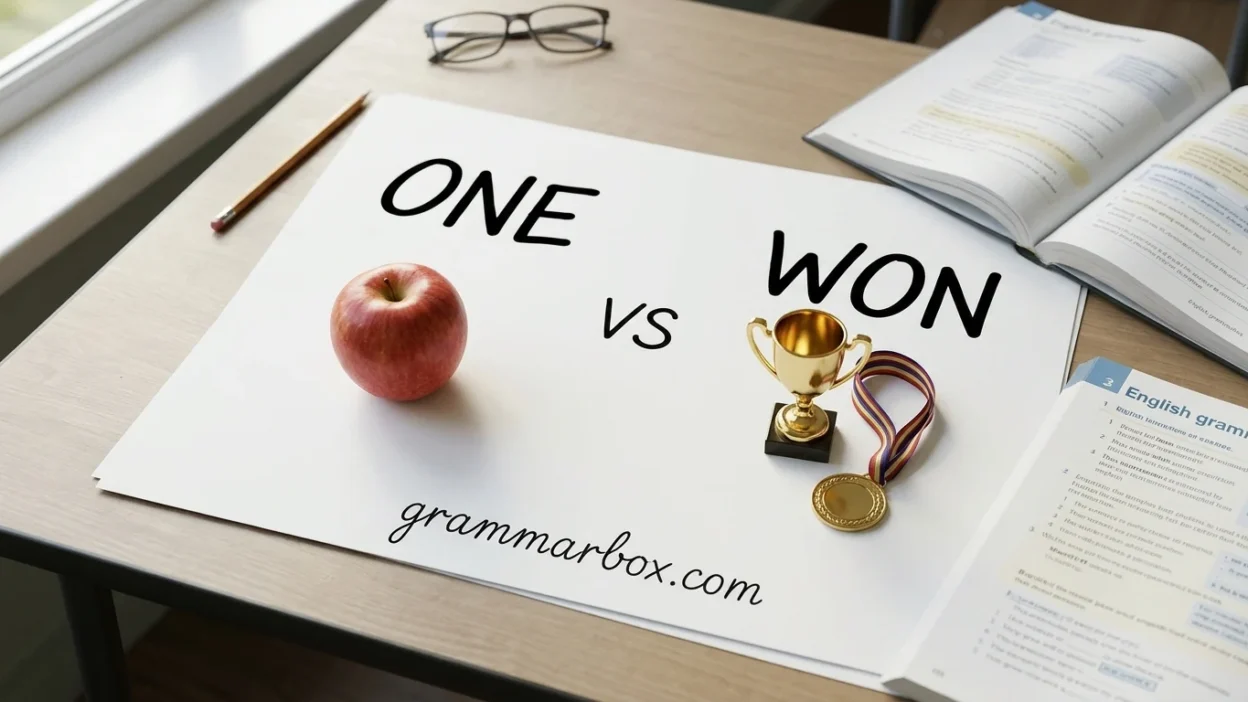
The English words one vs. won often confuse learners because they sound exactly the same but have different meanings and uses. Although both words are pronounced /wʌn/, they serve different purposes in sentences. One is a number, while the other is commonly used as the past tense of the verb “win.” Understanding this difference can help you improve your spelling, grammar, and everyday English communication.
If you are writing a school assignment, sending a message, or creating professional content, knowing when to use one or won is essential. These words are examples of homophones, which are words that sound alike but have different meanings and spellings. In this guide, you will learn the definitions of one and won, discover their grammatical roles, and explore practical examples that make the difference easy to remember. By the end, you will know exactly when to use each word without second-guessing yourself.
Quick Answer
One is the number 1 or a word used to refer to a single person or thing. Won is the past tense and past participle of “win,” meaning to achieve victory or receive a prize. Both words sound alike, but their meanings, spellings, and grammatical uses are different.
Why People Confuse It
People often confuse one and won because they have the same pronunciation. When speaking, you cannot hear a difference between these two words, so choosing the correct spelling depends on understanding the sentence.
Both words are also short and common in everyday English, which makes spelling mistakes easy to overlook.
Here are the main reasons for the confusion:
- Identical pronunciation: Both words sound like “wun.”
- Different meanings: One refers to a number or a single item, while won describes winning.
- Similar sentence positions: Both can appear in everyday sentences, but they perform different grammatical functions.
- Fast typing: Writers sometimes choose the wrong word when typing quickly or relying on automatic spelling suggestions.
For example:
- Correct: I have one brother.
- Correct: Our team won the match.
The first sentence refers to a quantity. The second describes a past victory.
First Word: One
One is a number that represents 1. It can also function as a pronoun, determiner, or noun, depending on the sentence.
Meaning of One
One can refer to a single person, object, unit, or item. It is used when counting, identifying something, or emphasizing that something exists individually.
Examples:
- I have one sister.
- Please give me one apple.
- Only one student answered the question.
- I need one more day to finish the project.
- This is the one I wanted to buy.
In each example, one refers to a single person, thing, or unit.
How to Use One in a Sentence
Use one when you want to express the number 1 or refer to a single item.
1. To express a quantity
- She bought one dress.
- We need one ticket for the event.
2. To replace a previously mentioned noun
- I like the blue shirt, but the red one is cheaper.
- My phone is old, so I want a new one.
3. To refer to a person in a general sense
- One should always tell the truth.
- One must be careful when crossing a busy road.
In these sentences, one can mean a person in general rather than a specific individual.
Synonyms and Related Words for One
Depending on the context, related words and expressions include:
- Single
- Individual
- Sole
- A single item
- First, when referring to a position or sequence
These words are not always interchangeable with one. For example, “one person” and “a single person” have similar meanings, but “one” and “first” serve different purposes.
Second Word: Won
Won is the past tense and past participle of the verb win. It describes achieving victory in a competition, succeeding in a challenge, or receiving something through winning.
Meaning of Won
Won indicates that someone achieved success or gained a prize, competition, or advantage.
Examples:
- Our school won the competition.
- She won a gold medal.
- He won the chess tournament.
- They won the championship last year.
- I won a prize in the lucky draw.
In each sentence, won describes a successful result.
How to Use Won in a Sentence
Use won when talking about a victory or achievement that has already happened.
1. To describe winning a competition
- Our team won the football match.
- She won first place in the spelling contest.
2. To describe receiving a prize
- He won a scholarship.
- They won two free tickets.
3. To describe gaining someone’s support or trust
- Her honesty won everyone’s respect.
- The candidate won the support of local voters.
The word won is not limited to sports. It can also describe success in relationships, arguments, elections, and other situations.
The Verb Forms of Win
Understanding the verb forms of win makes it easier to use won correctly.
| Verb Form | Word | Example |
|---|---|---|
| Base form | Win | I hope we win the game. |
| Present tense, third-person singular | Wins | She wins many competitions. |
| Simple past | Won | They won yesterday. |
| Past participle | Won | Our team has won three matches. |
| Present participle | Winning | He is winning the race. |
Remember that won is the past tense of win, not a spelling variation of one.
Comparison Table: One vs. Won
The following table summarizes the main differences between one and won.
| Feature | One | Won |
|---|---|---|
| Meaning | The number 1 or a single person or thing | Achieved victory or success |
| Part of speech | Number, determiner, pronoun, or noun | Verb form |
| Base form | One has no verb base form | Win |
| Pronunciation | /wʌn/ | /wʌn/ |
| Past tense | Not applicable | Won |
| Common usage | Counting and identifying items | Describing victory or success |
| Example | I have one book. | I won a book in a contest. |
| Related words | Single, individual | Win, wins, winning |
The easiest distinction: Use one for a quantity or a single item. Use won when someone has achieved victory or success.
When to Use Each
Choosing between one and won becomes easy when you focus on the meaning of your sentence.
Use One When Talking About Numbers
If you mean the number 1, choose one.
Examples:
- I need one cup of coffee.
- She has one younger brother.
- We waited for one hour.
Ask yourself: Am I counting something or referring to a single item? If yes, one is probably the correct choice.
Use One When Replacing a Noun
One can replace a noun that has already been mentioned.
Examples:
- I lost my pen, so I bought another one.
- The black shoes are nice, but I prefer the white ones.
In the second example, ones is the plural form used to replace a plural noun.
Use Won When Describing a Victory
If someone has won a game, competition, election, or prize, use won.
Examples:
- Our team won the final.
- She won a writing competition.
- He won the election.
Use Won with Helping Verbs
Won also appears with helping verbs such as has, have, and had.
Examples:
- She has won three awards.
- They have won several matches.
- He had won the competition before I arrived.
Quick test: If you can replace the word with “achieved victory,” use won. If you can replace it with “the number 1” or “a single item,” use one.
Examples of One vs. Won in Sentences
These examples show how one and won work in everyday English.
Examples Using One
- I have one question for the teacher.
- She bought one notebook from the store.
- Only one player scored a goal.
- Please bring me one glass of water.
- This is the one I was looking for.
- He waited for one hour outside the office.
- I prefer the blue shirt over the red one.
- One person can make a big difference.
- We need one more chair for the guest.
- She is the one who helped me yesterday.
Examples Using Won
- Our team won the football match.
- She won a gold medal at the tournament.
- He won the competition last weekend.
- They won a free vacation in a contest.
- My brother won the chess game.
- The candidate won the election.
- She won everyone’s trust through her honesty.
- We won the final after a difficult match.
- He has won several awards for his work.
- The young athlete won first place in the race.
Examples Using Both One and Won
These sentences make the difference even clearer.
- I bought one ticket, but my sister won two tickets.
- Only one team won the championship.
- She needed one more point before she won the game.
- He chose one prize after he won the contest.
- One student won the school spelling competition.
- I have one medal, but my brother has won three.
- They played one final match and won the tournament.
- Only one contestant won the grand prize.
- She bought one lottery ticket but never won anything.
- Our team needed one goal to win, and eventually we won.
These examples demonstrate that both words can appear in the same sentence while performing completely different jobs.
Common Mistakes
Writers sometimes use one and won incorrectly because the words sound identical. Understanding their meanings helps prevent these errors.
Mistake 1: Using Won Instead of One
Incorrect: I have won brother.
Correct: I have one brother.
Why? The sentence expresses a quantity, not a victory.
Mistake 2: Using One Instead of Won
Incorrect: Our team one the game.
Correct: Our team won the game.
Why? The sentence describes a past victory, so the correct word is won.
Mistake 3: Confusing Won with Win
Incorrect: She win the competition yesterday.
Correct: She won the competition yesterday.
Why? Yesterday indicates a completed event in the past, so the simple past tense won is appropriate.
Mistake 4: Using Won After Did
Incorrect: Did she won the race?
Correct: Did she win the race?
Why? After did, use the base form of the verb. Therefore, the correct expression is “did win,” not “did won.”
Mistake 5: Using One When Referring to a Victory
Incorrect: He one a gold medal.
Correct: He won a gold medal.
Why? Winning a medal describes an achievement, not a quantity.
Grammar tip: Always check the meaning of the sentence before choosing between homophones. A spell-checker may not catch these mistakes because both spellings are valid English words.
Memory Trick: How to Remember One vs. Won
A simple memory trick can help you distinguish one and won without memorizing complicated grammar rules.
Remember One = Number 1
The word one begins with the same letter as “only,” which can help you associate it with a single item.
Examples:
- One apple
- One student
- One chance
Think: One means one thing.
Remember Won = Victory
The word won comes from the verb win.
Examples:
- Won the game
- Won a prize
- Won the race
Think: Won means win in the past.
Try This Simple Test
Complete these sentences with one or won:
- She bought ___ dress.
- Our team ___ the match.
- I need ___ more minute.
- He ___ a scholarship.
Answers:
- One
- Won
- One
- Won
If the sentence refers to a single item, choose one. If it describes a past victory or achievement, choose won.
American vs. British English
The difference between one and won remains the same in American and British English.
Both varieties use one for the number 1 and won as the past tense and past participle of win. Their standard spellings and meanings do not change based on the country.
Examples in American English:
- I have one ticket.
- Our team won the game.
Examples in British English:
- I have one ticket.
- Our team won the match.
The main difference in these examples is the vocabulary used to describe sporting events. American English commonly uses “game,” while British English often uses “match” for certain sports.
However, both varieties use one and won according to the same grammatical rules.
Remember: One vs. won is not an American-versus-British spelling issue. The distinction is about meaning and grammatical function.
Similar Words: Homophones Like One and Won
One and won belong to a group of English words called homophones. Homophones sound the same but have different spellings or meanings.
Learning other common homophones can improve your spelling, vocabulary, and writing accuracy.
| Word Pair | Meaning | Example |
|---|---|---|
| Two / Too | Number 2 / Also or excessively | I have two books, too. |
| There / Their | A place / Belonging to them | Their bags are over there. |
| Hear / Here | Perceive sound / In this place | Come here so you can hear me. |
| Right / Write | Correct or a direction / Form words | Write the right answer. |
| See / Sea | Perceive with your eyes / Large body of salt water | I can see the sea. |
| Won / One | Achieved victory / Number 1 | One player won the game. |
| Sun / Son | The star / A male child | Her son enjoys the sunshine. |
| By / Buy | Near or through / Purchase | I will buy a book by that author. |
Understanding homophones is especially useful for students, English learners, writers, and anyone who wants to communicate clearly.
FAQs:
1. What Is the Difference Between One and Won?
One means the number 1 or a single person or thing. Won is the past tense and past participle of win, meaning to achieve victory or success. Although they sound the same, their meanings and grammatical uses are different.
2. Are One and Won Pronounced the Same?
Yes. In standard American and British English, one and won are pronounced the same way, usually represented as /wʌn/ in the International Phonetic Alphabet. Their meanings must be understood from the context of a sentence.
3. Is Won the Past Tense of Win?
Yes. Won is both the simple past form and the past participle of win.
Examples:
- I won the game yesterday.
- I have won several awards.
4. How Do You Use One in a Sentence?
Use one when referring to the number 1, a single item, or a person in a general sense.
Examples:
- I have one cat.
- This is the one I wanted.
- One should always be honest.
5. Is It One a Game or Won a Game?
The correct expression is won a game when describing a victory.
Example: “Our team won a game yesterday.”
Use one when counting: “Our team played one game yesterday.”
6. Why Do People Confuse One and Won?
People confuse these words because they sound identical but have different meanings and spellings. Since pronunciation does not help distinguish them, writers must use the context and grammatical role of the word.
7. Can One and Won Appear in the Same Sentence?
Yes. They can appear together when a sentence refers to a quantity and a victory.
Example: “One player won the competition.”
Here, one identifies a single player, while won describes the player’s achievement.
Final Verdict
The difference between one and won is simple once you understand their meanings. One refers to the number 1, a single person or thing, or a pronoun that replaces a noun. Won is the past tense and past participle of win and describes a victory, success, or achievement.
Although these words sound identical, they are not interchangeable. Choosing the correct word depends on what you want to communicate. If you are counting something, use one. If you are describing someone who achieved success, use won. Remembering this distinction will help you avoid common spelling mistakes and write more confidently.
Remember This
- One = 1: Use it when counting or referring to a single person or thing.
- Won = past tense of win: Use it when describing a victory or achievement.
- Both sound the same: Their pronunciation is identical in standard English.
- Check the context: Ask yourself whether the sentence describes a quantity or a victory.
Easy rule: One means a single thing; won means someone succeeded.