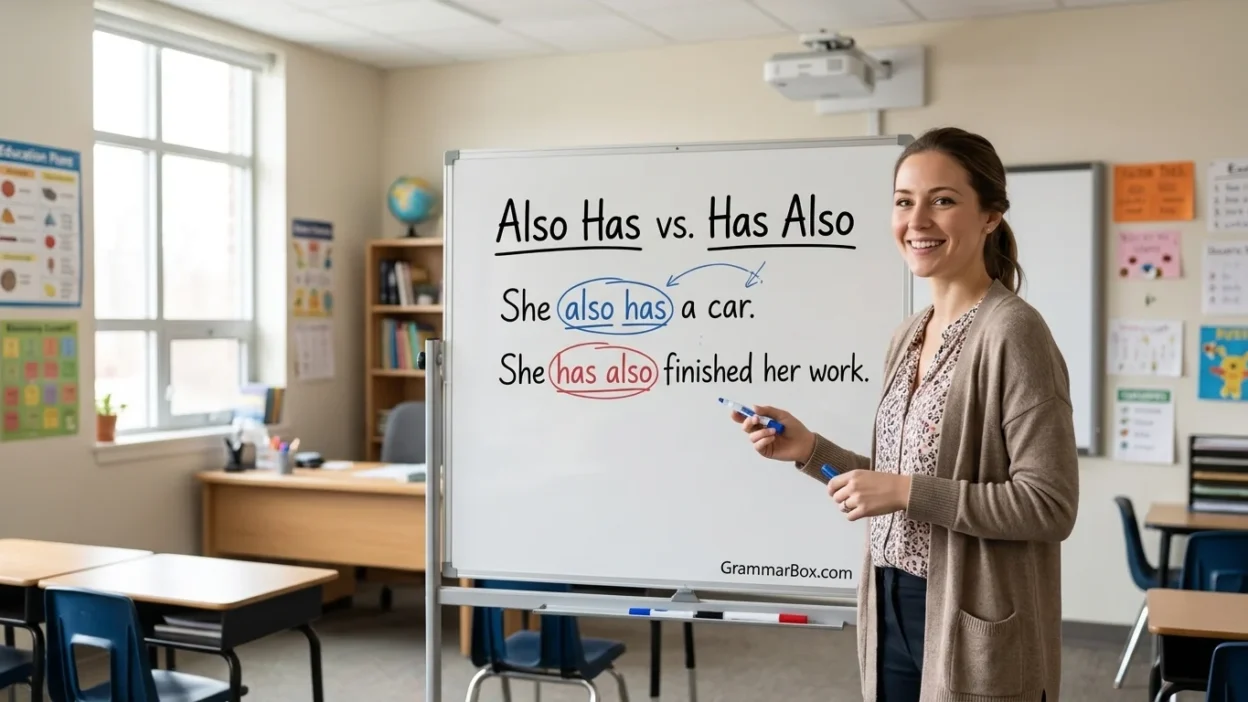
Have you ever wondered if to write “also has” or “has also” in a sentence? Both expressions are grammatically correct, but their placement can affect sentence flow, emphasis, and meaning. Choosing the right word order helps you communicate clearly and avoid common English grammar mistakes. Whether you are writing an email, completing a school assignment, or creating professional content, understanding this difference can improve your writing.
The confusion usually comes from the position of the adverb “also,” which means in addition or too. English allows this adverb to appear in different positions depending on the sentence structure and the emphasis you want to create. For example, you might write, “She also has a car” or “She has also purchased a car.” Both sentences use also naturally, but the surrounding verbs influence which position sounds best. In this guide, you will learn the difference between also has and has also, explore practical grammar rules, and discover examples that make choosing the correct expression easier.
Quick Answer
“Also has” and “has also” are both grammatically correct. Use “also has” when also comes before the main verb has. Use “has also” when also follows the auxiliary verb has and precedes a main verb, as in “She has also arrived.” The correct choice depends on the sentence structure.
Why People Confuse It
People often confuse also has and has also because both expressions communicate an additional fact or action. The word also generally means that something is added to information already mentioned.
However, English adverbs do not always appear in the same position. Their placement often depends on whether the sentence contains a main verb, an auxiliary verb, or a particular grammatical construction.
Consider these examples:
- Also has: Maria also has a bicycle.
- Has also: Maria has also bought a bicycle.
In the first sentence, has expresses possession, so also naturally appears before it. In the second sentence, has is an auxiliary verb that helps form the present perfect tense, so also appears after it and before the main verb bought.
The key is to identify how has functions in your sentence before deciding where to place also.
Also Has
What Does Also Has Mean?
“Also has” is a combination of the adverb also and the verb has. It commonly indicates that someone or something possesses an additional item, characteristic, responsibility, or quality.
The expression is especially natural when has is the main verb expressing possession or a state.
Examples:
- She also has a younger brother.
- My teacher also has a degree in mathematics.
- The company also has several international offices.
- He also has excellent communication skills.
- This phone also has a high-quality camera.
In each example, also introduces additional information about the subject.
When Should You Use Also Has?
Use also has when you want to add another fact about someone or something and has functions as the main verb.
For example:
- John has a laptop, and he also has a tablet.
- The school has a library and also has a science laboratory.
- My sister has a full-time job and also has a small business.
This construction works particularly well when discussing possession, characteristics, relationships, and responsibilities.
More Examples of Also Has
- Sarah also has a beautiful garden.
- Our manager also has experience in marketing.
- The restaurant also has vegetarian options.
- My brother also has a driving license.
- This application also has useful features.
These examples show how also has adds another detail without changing the basic meaning of the sentence.
Has Also
What Does Has Also Mean?
“Has also” places the adverb also after the auxiliary verb has. This construction is especially common in the present perfect tense, where has is followed by a past participle.
The present perfect describes actions or events connected to the present.
Examples:
- She has also completed her assignment.
- He has also visited London.
- The company has also announced its new policy.
- My teacher has also explained the lesson.
- The team has also won several awards.
In these sentences, has is an auxiliary verb, while the following verb expresses the action.
When Should You Use Has Also?
Use has also when has helps form a verb phrase, particularly the present perfect tense.
The common structure is:
Subject + has + also + past participle + other information
Examples:
- She has also finished her homework.
- Daniel has also learned Spanish.
- The organization has also introduced new programs.
- The doctor has also recommended additional tests.
- Our school has also organized a science exhibition.
The adverb also appears between the auxiliary verb has and the main verb.
This position is natural in standard English and is particularly useful when describing additional completed actions or developments.
Can Has Also Express Possession?
Yes, but its use with possession requires attention to sentence structure and emphasis.
For example:
- He has also a car.
This sentence may occur in some varieties of English or formal, older-fashioned writing, but it sounds unnatural to many speakers of contemporary English.
For ordinary statements about possession, prefer:
- He also has a car.
However, has also is entirely natural when another verb follows it:
- He has also purchased a car.
The distinction is not simply about which phrase is correct. It is about how has functions in the sentence.
Comparison Table
| Feature | Also Has | Has Also |
|---|---|---|
| Grammatical correctness | Correct | Correct |
| Common structure | Subject + also + has | Subject + has + also + main verb |
| Typical use | Possession or characteristics | Additional actions, especially present perfect |
| Verb function | Usually a main verb | Usually an auxiliary verb |
| Example | She also has a dog. | She has also adopted a dog. |
| Naturalness | Very natural for possession | Very natural before a past participle |
| Main purpose | Adds another fact about possession or a state | Adds another action or development |
| Common mistake | Confusing it with an auxiliary construction | Using it awkwardly before a noun in ordinary possession statements |
Important: These are common patterns, not absolute rules for every possible sentence. Adverb placement can vary with verb type, emphasis, and writing style.
When to Use Each
Choosing between also has and has also becomes easier when you identify the role of has.
1. Use Also Has for Possession
When has means that someone owns or possesses something, also has is generally the most natural choice.
Examples:
- Emma also has a new computer.
- My father also has a small business.
- The house also has a swimming pool.
Here, has is the main verb.
2. Use Has Also for Additional Actions
When has functions as an auxiliary verb followed by a past participle, place also between the auxiliary and the main verb.
Examples:
- Emma has also purchased a new computer.
- My father has also started a business.
- The company has also expanded its services.
These sentences use the present perfect tense.
3. Consider the Verb Structure
Before choosing the expression, look at the words following has.
- Also has a car: Has expresses possession.
- Has also bought a car: Has helps form the present perfect.
This simple check will help you choose the more natural construction.
4. Keep Your Sentence Natural
Although adverb placement can vary, some positions sound more natural than others in everyday English.
For example:
- Natural: She also has a laptop.
- Natural: She has also purchased a laptop.
- Less natural in everyday English: She has also a laptop.
When writing for a general audience, prioritize familiar, natural sentence patterns.
Examples of Also Has vs. Has Also
Here are 15 examples showing how these expressions work in different contexts.
| No. | Also Has | Has Also |
|---|---|---|
| 1 | She also has a cat. | She has also adopted a cat. |
| 2 | He also has a new job. | He has also started a new job. |
| 3 | My friend also has a car. | My friend has also bought a car. |
| 4 | The school also has a library. | The school has also opened a new library. |
| 5 | Sarah also has a degree. | Sarah has also earned a degree. |
| 6 | Our company also has international clients. | Our company has also gained international clients. |
| 7 | My brother also has a bicycle. | My brother has also repaired his bicycle. |
| 8 | The hotel also has a swimming pool. | The hotel has also renovated its swimming pool. |
| 9 | This phone also has a large screen. | This phone has also received a software update. |
| 10 | The teacher also has a question. | The teacher has also asked a question. |
Notice that the first column generally describes possession or an existing characteristic, while the second column describes an additional action or development.
More Examples in Everyday English
- Also has: Our neighbor also has two dogs.
- Has also: Our neighbor has also adopted a puppy.
- Also has: The restaurant also has outdoor seating.
- Has also: The restaurant has also introduced a new menu.
- Also has: The student also has excellent writing skills.
These examples demonstrate the most common patterns used in everyday conversations and formal writing.
Common Mistakes
Even experienced English learners sometimes place also incorrectly. Understanding the following mistakes can help you write more naturally.
Mistake 1: Using Has Also Awkwardly for Possession
Less natural: She has also a laptop.
Better: She also has a laptop.
In contemporary everyday English, also has is generally preferred when has expresses possession.
Mistake 2: Forgetting the Past Participle
Incorrect: He has also complete the project.
Correct: He has also completed the project.
When using has to form the present perfect, follow it with a past participle. In this example, completed is the past participle.
Mistake 3: Confusing Has and Have
Incorrect: They has also finished the work.
Correct: They have also finished the work.
Use has with third-person singular subjects such as he, she, and it. Use have with I, you, we, and they.
Mistake 4: Assuming One Expression Is Always Correct
Incorrect assumption: You must always write has also because it sounds more formal.
Better understanding: Both expressions are correct, but they serve different grammatical patterns.
For example:
- She also has a notebook.
- She has also written a note.
Both are natural because the sentence structures differ.
Mistake 5: Placing Also in an Unnatural Position
Less natural: He has a car also.
More natural: He also has a car.
Although also can appear at the end of some sentences, its placement before the main verb is often smoother in ordinary statements about possession.
Memory Trick
Remember this simple rule:
Possession = Also Has
Additional action = Has Also
Think of the following examples:
- She also has a bicycle.
She possesses another item. - She has also bought a bicycle.
She has completed an additional action.
Another helpful trick is to check whether a main verb follows has.
If has is the main verb expressing possession, also has is usually the natural choice.
If has is an auxiliary verb followed by a past participle, has also is usually the natural choice.
Keep this distinction in mind, and you will find it much easier to use both expressions correctly.
American vs. British English
The basic grammatical distinction between also has and has also is the same in American and British English.
Both varieties commonly use also has for possession and has also with the present perfect.
American English examples:
- She also has a car.
- She has also completed the assignment.
British English examples:
- She also has a car.
- She has also completed the assignment.
There is no major American-versus-British spelling difference between these expressions.
However, regional preferences can influence sentence rhythm, formality, and the use of particular verb constructions. In everyday British English, speakers may also use have got to express possession.
For example:
- She has also got a car.
- She also has a car.
Both constructions can be acceptable, although their use depends on context and style.
The important point is that the difference between also has and has also is primarily grammatical, not geographical.
Similar Words and Expressions
Understanding other adverbs can help you improve your English sentence structure.
1. Also vs. Too
Both words add information, but their usual positions differ.
- She also has a laptop.
- She has a laptop, too.
Also commonly appears before the main verb, while too often appears at the end of a sentence.
2. Also vs. As Well
As well is another expression meaning in addition.
- He also has a bicycle.
- He has a bicycle as well.
Both sentences communicate a similar idea.
3. Has Also vs. Have Also
The difference depends on the subject.
- She has also completed the task.
- They have also completed the task.
Use has with third-person singular subjects and have with plural subjects, as well as I and you.
4. Has Been vs. Has Also Been
Has been can describe a state or help form a continuous or passive construction. Adding also introduces an additional fact.
Examples:
- She has been busy.
- She has also been busy lately.
The second sentence indicates that being busy is another relevant fact.
5. Also Did vs. Did Also
These expressions illustrate a similar issue with adverb placement.
- She also completed the task.
- She did also complete the task.
The first sentence is more natural in most everyday contexts. The second may be used for emphasis or in particular formal contexts.
Learning these patterns helps you understand that adverb placement depends on both grammar and intended emphasis.
FAQs:
1. Is Also Has Grammatically Correct?
Yes. Also has is grammatically correct when has functions as the main verb, especially when expressing possession or a characteristic.
Example: He also has a bicycle.
2. Is Has Also Grammatically Correct?
Yes. Has also is grammatically correct, particularly when has is an auxiliary verb in the present perfect tense.
Example: He has also purchased a bicycle.
3. What Is the Difference Between Also Has and Has Also?
The main difference is word order and verb function. Also has commonly describes additional possession, while has also commonly introduces an additional action formed with the present perfect tense.
4. Can I Say She Has Also a Car?
Although this construction may occur in some varieties of English or formal writing, it sounds unnatural to many speakers today.
For natural everyday English, write “She also has a car.”
5. Should Also Come Before or After Has?
It depends on the sentence structure. Use also has when has is the main verb expressing possession. Use has also when has is an auxiliary verb followed by a main verb.
6. Is Has Also More Formal Than Also Has?
Not necessarily. Neither expression is inherently more formal. The appropriate choice depends on the grammatical construction, rather than formality alone.
7. Do American and British English Use These Expressions Differently?
The main rules are the same in both varieties. Both American and British English commonly use also has for possession and has also before a past participle.
Remember This
- Also has: She also has a dog.
- Has also: She has also adopted a dog.
- Both expressions are grammatically correct.
- Use the sentence structure to decide which expression sounds most natural.
- In ordinary possession statements, also has is generally preferred.
Conclusion
Understanding the difference between also has and has also can make your English writing clearer and more natural. Although both expressions add information, their placement depends on how the verb has functions in a sentence. When it expresses possession, also has is usually the better choice. When it helps form the present perfect tense, has also is generally appropriate.
The best way to remember this grammar rule is to practice with everyday examples. Write sentences about things people own and actions they have completed, paying attention to the position of also. With regular practice, you will recognize the correct structure more quickly and avoid common word-order mistakes in conversations, schoolwork, emails, and professional writing.