The phrases aim at and aim for look similar, but they can express different meanings depending on the situation. Both are used when talking about targets, goals, intentions, and directions. However, choosing the correct preposition helps you communicate your message more clearly. Whether you are writing an academic assignment, preparing a professional email, or improving your everyday English, understanding the difference between these expressions can make your writing more natural.
One helpful way to distinguish them is to consider whether you are directing something toward a target or trying to achieve a particular result. For example, you might aim at a target during a shooting competition, but you might aim for a promotion when planning your career. Both phrases can describe goals, and their meanings sometimes overlap, so context matters. In this guide, you will learn the meanings of aim at and aim for, discover their grammatical patterns, explore practical examples, and understand common mistakes. By the end, you will know how to use both expressions confidently in everyday conversations and formal writing.
Quick Answer
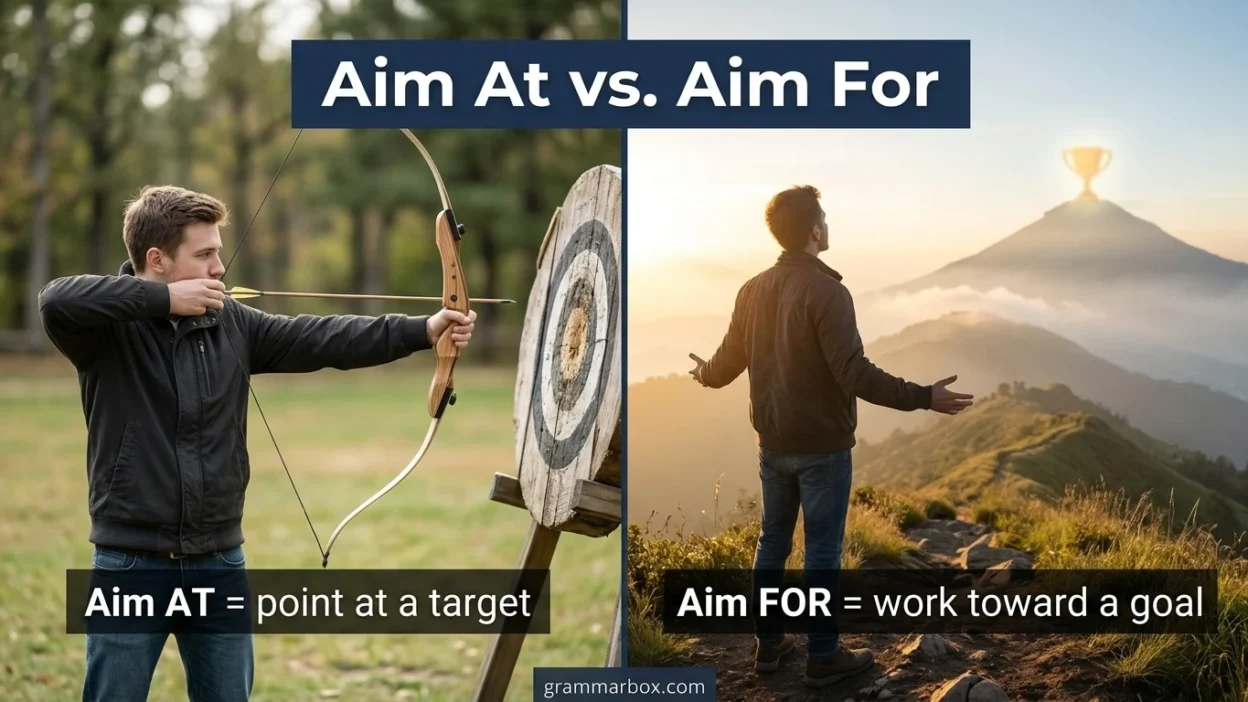
Aim at usually means directing something toward a target or focusing an action on a particular person, group, or objective. Aim for commonly means trying to achieve a goal, result, or standard. For example, you aim at a target but aim for success. The best choice depends on the intended meaning.
Why People Confuse It
People often confuse aim at vs aim for because both expressions can refer to targets and objectives. The difference is not always obvious, especially when the target is an abstract goal rather than a physical object.
For example:
- Aim at: The campaign aims at young adults.
- Aim for: The campaign aims for a wider audience.
The first sentence emphasizes the group the campaign targets. The second emphasizes the audience the campaign hopes to reach.
Another reason for confusion is that both prepositions can appear in sentences about ambition. However, at often emphasizes the target or focus, while for frequently emphasizes the desired outcome.
Understanding this distinction will help you choose the appropriate phrase in different contexts.
First Word: Aim At
Aim at means to direct something toward a particular target, focus on a specific audience, or intend to achieve a particular purpose.
The phrase can describe physical actions, communication, business strategies, and intentions.
1. Directing Something Toward a Target
Use aim at when something is pointed toward a physical target.
Examples:
- The archer aimed at the center of the target.
- The player aimed at the goal.
- The photographer aimed the camera at the building.
- The security guard aimed the flashlight at the doorway.
In these examples, at identifies the direction or target of the action.
2. Targeting a Particular Audience
The phrase can also describe products, advertisements, lessons, or campaigns designed for a particular group.
Examples:
- The advertisement is aimed at teenagers.
- This course is aimed at beginners.
- The company launched a campaign aimed at small businesses.
In these sentences, aimed at identifies the intended audience.
3. Focusing on a Specific Objective
Aim at can describe an action intended to produce a particular effect.
Examples:
- The new policy aims at reducing unnecessary expenses.
- The training program aims at improving employee performance.
- Her criticism was aimed at the company’s management.
In these contexts, the phrase emphasizes the target or focus of an action.
Grammar tip: In formal writing, aim at can be followed by a noun or an -ing form when describing an intended action.
For example:
- The project aims at improving public transportation.
- The campaign is aimed at raising awareness.
Second Word: Aim For
Aim for commonly means to try to achieve, obtain, or reach something. It emphasizes a desired outcome, goal, or standard.
This expression is particularly common when discussing personal ambitions, professional plans, education, and performance.
1. Working Toward a Goal
Use aim for when describing something you want to achieve.
Examples:
- I aim for success in my career.
- She is aiming for a promotion.
- We aim for better results this year.
- He aims for excellence in everything he does.
The phrase highlights the result someone hopes to achieve.
2. Setting a Target or Standard
Aim for is useful when discussing measurable goals, performance levels, or expectations.
Examples:
- Aim for a score of at least 90 percent.
- We are aiming for a 20 percent increase in sales.
- The team aims for consistent improvement.
- Try to aim for a balanced diet.
These sentences describe desired standards or outcomes.
3. Choosing a Desired Result
The expression can also describe decisions and plans directed toward a particular result.
Examples:
- Our organization aims for long-term growth.
- The school aims for higher graduation rates.
- I am aiming for a more balanced work-life routine.
- They are aiming for a successful launch next month.
Grammar tip: Aim for is commonly followed by a noun phrase, such as a promotion, success, or better results.
Compare these examples:
- We aim at improving customer service.
- We aim for better customer service.
Both can be grammatical, but the first emphasizes the action or focus of improvement, while the second emphasizes the desired outcome.
Comparison Table: Aim At vs Aim For
| Feature | Aim At | Aim For |
|---|---|---|
| Main meaning | Direct attention or action toward a target | Try to achieve a goal or result |
| Common use | Targeting, focusing, directing | Ambition, goals, desired outcomes |
| Physical target | Aim at the target | Aim for the target when trying to hit it |
| Career example | The campaign is aimed at job seekers. | She is aiming for a promotion. |
| Academic example | The lesson is aimed at beginners. | He is aiming for a higher grade. |
| Business example | The advertisement is aimed at young customers. | The company is aiming for higher profits. |
| Common pattern | Aim at + noun or -ing form | Aim for + noun phrase |
| Main emphasis | Target or focus | Desired achievement |
Important: These meanings overlap. For example, aim at success can mean trying to achieve success, while aim for the target can describe trying to hit a physical target. Context determines the intended meaning.
When to Use Each
Choosing between aim at and aim for becomes easier when you identify what the sentence is trying to communicate.
Use Aim At When You Mean Target or Focus
Choose aim at when the emphasis is on the person, group, object, or activity being targeted.
Examples:
- The advertisement is aimed at college students.
- The speaker aimed his comments at the opposition.
- The program aims at helping disadvantaged communities.
- The photographer aimed the lens at the mountains.
Ask yourself: What is being targeted or focused on?
If the sentence emphasizes a target or focus, aim at may be the appropriate choice.
Use Aim For When You Mean Achieve or Reach
Choose aim for when someone wants to accomplish a goal or reach a particular standard.
Examples:
- I am aiming for a better job.
- We aim for excellent customer service.
- She aims for a top position in her field.
- The team is aiming for victory.
Ask yourself: What result does someone want to achieve?
If the sentence emphasizes a desired result, aim for is often the better choice.
When Both Expressions Are Possible
Sometimes, both expressions are correct but emphasize different aspects of the same situation.
Consider these examples:
- The campaign aims at reducing plastic waste.
- The campaign aims for a significant reduction in plastic waste.
The first sentence emphasizes the action of reducing plastic waste. The second emphasizes the desired result: a significant reduction.
Similarly:
- The program is aimed at improving reading skills.
- The program aims for better reading outcomes.
Both describe an educational objective, but their grammatical structures and emphasis differ.
Examples of Aim At vs Aim For
Here are 16 examples showing how to use both phrases naturally.
Examples With Aim At
- The teacher designed the lesson to aim at improving students’ writing skills.
- The advertisement is aimed at young professionals.
- The archer aimed at the center of the target.
- The criticism was aimed at the company’s leadership.
- The campaign aims at reducing food waste.
- The photographer aimed the camera at the sunset.
- This introductory course is aimed at English learners.
- The new initiative aims at improving access to education.
Examples With Aim For
- I am aiming for a promotion next year.
- Our team aims for better results this season.
- She aims for a score of 95 percent.
- The company is aiming for higher profits.
- We should aim for a realistic deadline.
- He is aiming for a career in medicine.
- The athletes are aiming for a gold medal.
- My goal is to aim for steady progress rather than perfection.
Examples Where Meaning Depends on Context
Consider these additional sentences:
- The company aims at expanding its customer base.
- The company aims for a larger customer base.
The first emphasizes the action of expanding. The second emphasizes the desired outcome.
Another pair:
- The organization aims at helping local families.
- The organization aims for better outcomes for local families.
The first emphasizes the organization’s focus or intended activity. The second highlights the results it hopes to achieve.
These distinctions are useful, but they are not absolute rules. English speakers sometimes use the expressions interchangeably when the intended meaning is clear.
Common Mistakes
Even advanced English learners can confuse aim at and aim for. The following mistakes are worth avoiding.
Mistake 1: Using Aim At for Every Goal
Incorrect or less natural in many contexts:
- I am aiming at a promotion.
This sentence is possible in some contexts, but I am aiming for a promotion is the more natural choice when describing a career goal.
Better: I am aiming for a promotion.
Mistake 2: Using Aim For When Describing a Targeted Audience
Less natural:
- This course is aimed for beginners.
Better: This course is aimed at beginners.
When describing the intended audience of a course, advertisement, or campaign, use aimed at.
Mistake 3: Confusing the Prepositions After Aim
Incorrect:
- We aim success.
- She aims a better future.
Better:
- We aim for success.
- She aims for a better future.
In these examples, the preposition for connects the verb aim to the desired outcome.
Mistake 4: Forgetting the -ing Form
Incorrect in standard usage:
- The project aims at improve public services.
Correct:
- The project aims at improving public services.
When aim at is followed by a verb, use the gerund form ending in -ing.
Mistake 5: Assuming the Two Expressions Never Overlap
It is incorrect to assume that aim at always refers to physical targets and aim for always refers to abstract goals.
For example, you can aim at success when discussing an intended objective. You can also aim for a target when trying to hit it.
The intended meaning and sentence structure determine which expression works best.
Memory Trick: How to Remember the Difference
A simple memory trick can help you choose the right phrase.
Remember: At = Target; For = Goal.
- Aim at: Think about the target your attention or action is directed toward.
- Aim for: Think about the result you hope to achieve.
For example:
- The advertisement is aimed at students. Students are the target audience.
- She is aiming for success. Success is her desired goal.
You can also remember this simple sentence:
Aim at what you target; aim for what you want to achieve.
This is a useful general guideline, although the two expressions can overlap in some situations.
American vs British English
There is no major difference between American and British English in the basic meanings of aim at and aim for. Both expressions are standard in both varieties of English.
American English examples:
- We are aiming for higher sales this year.
- This program is aimed at high school students.
- She aims for a leadership position.
British English examples:
- We are aiming for better results this year.
- This programme is aimed at university students.
- He aims for a successful career.
The main spelling difference in these examples is program in American English versus programme in many British English contexts. British English generally uses program for computer software.
The choice between aim at and aim for depends on meaning, not on whether you are writing in American or British English.
Similar Words and Expressions
Several other English expressions can communicate ideas related to aim at and aim for. Understanding their meanings can help you choose more precise language.
1. Aim Toward
Meaning: To move or direct yourself toward a goal or destination.
Example: The organization aims toward long-term sustainability.
Aim toward emphasizes direction or movement toward an objective.
2. Strive For
Meaning: To make a serious effort to achieve something.
Example: She strives for excellence in her work.
Use strive for when you want to emphasize effort and determination.
3. Target
Meaning: To direct an action toward a particular person, group, or objective.
Example: The company targets young professionals with its new campaign.
Target can replace aim at in many marketing and audience-related contexts.
4. Aspire To
Meaning: To have a strong desire to achieve something important.
Example: He aspires to become a successful writer.
Use aspire to when describing a long-term ambition. It is commonly followed by a noun or a verb in the infinitive form.
5. Work Toward
Meaning: To make progress toward a goal through effort.
Example: We are working toward a more sustainable future.
This expression emphasizes the steps taken to reach an objective.
6. Seek
Meaning: To try to obtain, find, or achieve something.
Example: The organization seeks better solutions to environmental problems.
Seek is often more formal than aim for.
FAQs:
1. Is It Aim At or Aim For?
Both expressions are correct, but they often have different uses. Aim at emphasizes a target or focus, while aim for commonly emphasizes a desired result or goal. For example, a course is aimed at beginners, but a student aims for a high grade.
2. Is Aim At Grammatically Correct?
Yes. Aim at is grammatically correct when used with an appropriate object. For example, you can aim at a target, aim a camera at a building, or describe a campaign aimed at students.
3. Is Aim For Grammatically Correct?
Yes. Aim for is correct when describing something someone wants to achieve or reach. Examples include aiming for success, aiming for a promotion, and aiming for a higher score.
4. Can I Say Aim At Success?
Yes. Aim at success is grammatically possible and can mean trying to achieve success. However, aim for success is often more natural when describing a desired outcome.
5. Can I Say Aim For a Target?
Yes. Aim for a target is correct when you are trying to hit or reach a target. For example, an archer may aim for the center of a target. You can also say aim at the target, which emphasizes the direction of the shot.
6. What Is the Difference Between Aimed At and Aimed For?
Aimed at usually identifies the target, audience, or focus of an action. Aimed for often identifies the desired goal or result. For example, a course is aimed at beginners, while a student is aiming for a higher grade.
7. Is Aim At More Formal Than Aim For?
Neither expression is inherently more formal. Both are common in everyday conversation, academic writing, and professional communication. The correct choice depends on the meaning you want to express.
Final Verdict: Aim At vs Aim For
The difference between aim at and aim for becomes easier to understand when you focus on the intended meaning. Aim at commonly emphasizes a target, audience, or focus, while aim for commonly emphasizes a goal, achievement, or desired result.
For example, a company might create an advertisement aimed at students while aiming for increased sales. The advertisement targets a particular audience, and the company hopes to achieve a business objective.
Remember that these expressions sometimes overlap. You can aim at a goal or aim for a physical target, depending on the context. Instead of memorizing rigid rules, pay attention to what the sentence emphasizes and choose the preposition that communicates your meaning most naturally.
Conclusion
Understanding aim at vs aim for can improve your English grammar, vocabulary, and writing clarity. Although both expressions are associated with targets and objectives, aim at generally highlights the focus of an action, while aim for often highlights the result someone wants to achieve. Learning these common patterns will help you use both phrases more confidently in academic assignments, professional communication, and everyday conversations.
The best way to remember the difference is to practice with realistic examples. Think about whether you are describing a target, such as an audience or object, or a goal, such as success or a promotion. Then choose the expression that best fits the intended meaning. With regular practice, selecting between aim at and aim for will become more natural.
Remember This
- Aim at = Direct attention or action toward a target, audience, or focus.
- Aim for = Try to achieve a goal, result, or standard.
- Example: The course is aimed at beginners, and its creators aim for excellent learning outcomes.
- Grammar tip: Use aim at + noun/-ing form and aim for + noun phrase in these common patterns.
- Important: The expressions can overlap, so always consider the context.