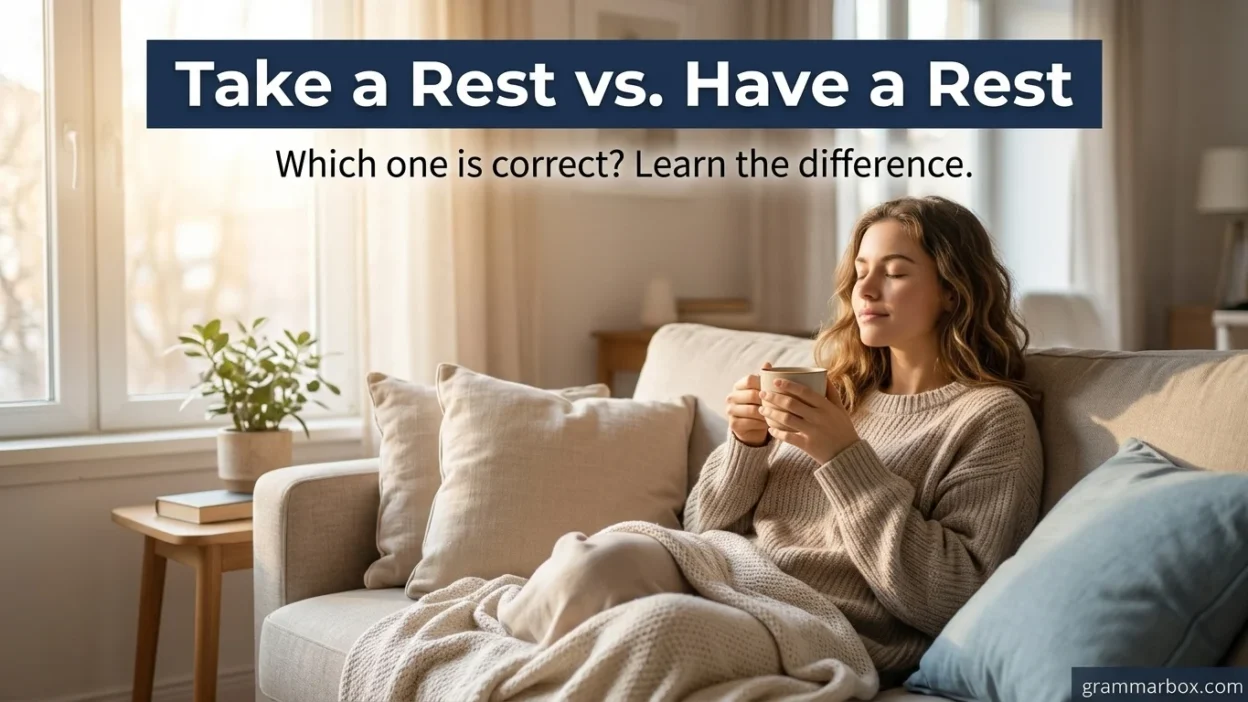
Have you ever wondered whether to say “take a rest” or “have a rest” when you want to tell someone to relax for a while? Both expressions are grammatically correct, and both communicate the idea of stopping an activity to relax or recover your energy. However, their usage can vary depending on the speaker, the region, and the context. Understanding these small differences can help you sound more natural in everyday English.
English learners often find these expressions confusing because both use common verbs followed by the same noun. Although their meanings are almost identical, some speakers prefer one expression over the other. You might hear “take a rest” in conversations about recovering after exercise, while “have a rest” is particularly familiar in British English. In this guide, you will learn what each phrase means, how to use it correctly, and which expression is more suitable for different situations. With practical examples and simple explanations, you can confidently choose the right phrase in conversations, emails, and everyday writing.
Quick Answer
“Take a rest” and “have a rest” both mean to stop working or doing an activity for a while to relax and recover your energy. “Have a rest” is especially common in British English, while “take a rest” is also widely understood. Both are correct, but “take a break” is often more natural in American English.
Why People Confuse It
People confuse “take a rest” and “have a rest” because the expressions share the same meaning and grammatical structure. Both use a verb followed by the noun “rest,” which refers to a period of relaxation or recovery.
For example:
- I need to take a rest after exercising.
- I need to have a rest after exercising.
Both sentences are grammatically correct and communicate the same basic idea.
The confusion comes from English collocations, which are combinations of words that commonly appear together. Although English speakers can understand both expressions, their preferences may differ depending on their dialect and the situation.
Another reason for the confusion is that English has several similar expressions, including “take a break,” “have a break,” and “get some rest.” Learning when to use these alternatives makes everyday communication easier.
First Word: Take a Rest
“Take a rest” means to stop an activity temporarily so you can relax, regain your strength, or recover from tiredness.
The verb “take” frequently appears in English expressions describing actions or periods of time. Examples include “take a break,” “take a nap,” and “take a walk.”
Similarly, “take a rest” emphasizes the action of allowing yourself some time to relax.
When to Use Take a Rest
You can use “take a rest” in situations involving physical activity, tiredness, or the need to pause and recover.
Examples include:
- After exercising: “You should take a rest before continuing your workout.”
- During a long journey: “Let’s take a rest before driving any farther.”
- After physical work: “The workers decided to take a rest after carrying the heavy boxes.”
- When feeling tired: “I need to take a rest because I haven’t slept well.”
The expression is understandable in both American and British English, although other expressions may sound more natural in particular contexts.
Example Sentences With Take a Rest
- I need to take a rest after walking for three hours.
- The doctor advised him to take a rest after the exhausting journey.
- Let’s take a rest before climbing the next hill.
- She decided to take a rest after cleaning the entire house.
- You should take a rest if you feel exhausted.
- The players took a rest during their training session.
- He sat under a tree to take a rest.
- We stopped the car to take a rest during our road trip.
- After working in the garden all morning, Dad wanted to take a rest.
- If your legs hurt, take a rest before continuing your walk.
These examples show how “take a rest” can describe a temporary pause for physical recovery or relaxation.
Second Word: Have a Rest
“Have a rest” means to spend some time relaxing or recovering after an activity. It is a natural expression in British English and is commonly used in everyday conversation.
The verb “have” appears in many English expressions that describe experiences, activities, or periods of time. For example, people say “have a shower,” “have a chat,” and “have a break.”
In the same way, “have a rest” describes taking time to relax.
When to Use Have a Rest
You can use “have a rest” when suggesting that someone relax or explaining that you need time to recover.
Examples include:
- Suggesting relaxation: “You look tired. Why don’t you have a rest?”
- After household chores: “I’ll have a rest after washing the dishes.”
- During a busy day: “Let’s have a rest before starting the next task.”
- When caring for someone: “You should have a rest if you’re feeling tired.”
The expression is especially familiar to British English speakers. American English speakers will generally understand it, but they may prefer “take a break” in many everyday situations.
Example Sentences With Have a Rest
- You look exhausted, so you should have a rest.
- We had a rest after walking around the city.
- She wants to have a rest before preparing dinner.
- Let’s have a rest under this shady tree.
- My grandfather usually has a rest after lunch.
- The children had a rest after playing outside.
- You can have a rest while I finish the work.
- He decided to have a rest before leaving for the airport.
- After gardening for two hours, we had a rest.
- If you feel tired, sit down and have a rest.
These sentences demonstrate how “have a rest” works in everyday conversations, particularly in British English.
Take a Rest vs Have a Rest: Comparison Table
| Feature | Take a Rest | Have a Rest |
|---|---|---|
| Meaning | To stop an activity and recover | To spend time relaxing or recovering |
| Grammatical correctness | Correct | Correct |
| British English | Understood and used | Particularly common |
| American English | Understood, though alternatives may be preferred | Understood, but may sound less typical |
| Everyday usage | Often associated with pausing to recover | Often used when suggesting or describing relaxation |
| Example | I need to take a rest after running. | I need to have a rest after running. |
| Similar expression | Take a break | Have a break |
| Best general alternative | Take a break | Take a break |
Key point: There is no major difference in meaning between “take a rest” and “have a rest.” Your choice can depend on regional preferences and the sentence’s context.
When to Use Each
Choosing between these expressions becomes easier when you consider your audience and the situation.
1. Use Take a Rest When Talking About Recovery
“Take a rest” works when someone needs to pause after physical activity or demanding work.
Examples:
- You should take a rest after running five miles.
- I need to take a rest before carrying these boxes.
- The hikers stopped to take a rest.
In many of these situations, “take a break” is another natural option.
2. Use Have a Rest in British English
“Have a rest” is a familiar expression in British English, especially in casual conversation.
Examples:
- You look tired. Have a rest.
- Let’s have a rest before lunch.
- She had a rest after finishing her work.
These sentences sound natural to many British English speakers.
3. Use Take a Break in Everyday American English
If you are communicating with an American audience, “take a break” is often a natural choice.
Examples:
- I need to take a break from studying.
- Let’s take a break before the next meeting.
- You should take a break if you’re feeling tired.
“Take a break” is also widely used in British English, so it is a useful expression for international communication.
4. Use Get Some Rest When You Need Recovery
“Get some rest” is another common expression, especially when someone needs sleep or recovery.
Examples:
- You look exhausted. You should get some rest.
- I need to get some rest before tomorrow’s exam.
- The doctor told him to get plenty of rest.
Unlike “take a rest” and “have a rest,” this expression often emphasizes obtaining enough rest rather than simply taking a short break.
Examples: Take a Rest vs Have a Rest in Everyday English
The following examples show how both expressions work in similar situations.
| Situation | Take a Rest | Have a Rest |
|---|---|---|
| After exercise | I need to take a rest after exercising. | I need to have a rest after exercising. |
| After work | She took a rest after work. | She had a rest after work. |
| During a journey | We stopped to take a rest. | We stopped to have a rest. |
| After studying | He took a rest after studying. | He had a rest after studying. |
| In the garden | They took a rest under a tree. | They had a rest under a tree. |
| After cleaning | I took a rest after cleaning the kitchen. | I had a rest after cleaning the kitchen. |
| During a hike | The hikers took a rest on the hill. | The hikers had a rest on the hill. |
| After playing | The children took a rest after playing football. | The children had a rest after playing football. |
| At lunchtime | She took a rest after lunch. | She had a rest after lunch. |
| Before working again | We took a rest before continuing. | We had a rest before continuing. |
| When feeling tired | He took a rest because he felt tired. | He had a rest because he felt tired. |
| After a long day | I took a rest in the evening. | I had a rest in the evening. |
Both expressions are grammatically correct in these examples. The best choice depends on your preferred variety of English and the expression that sounds most natural in context.
Common Mistakes
English learners sometimes use these phrases incorrectly or choose an expression that does not fit the situation.
Mistake 1: Thinking One Expression Is Always Wrong
Incorrect assumption: “Have a rest” is wrong English.
Correction: Both “take a rest” and “have a rest” are correct expressions. They have essentially the same meaning.
Mistake 2: Confusing Rest With Sleep
Resting does not always mean sleeping.
For example:
- I took a rest on the sofa while listening to music.
- I had a rest in the garden after working.
In both sentences, the person can relax without falling asleep.
Mistake 3: Forgetting the Article
When using “rest” as a countable noun in these expressions, include the article “a.”
Correct:
- I need to take a rest.
- She wants to have a rest.
Incorrect:
- I need to take rest.
- She wants to have rest.
However, “rest” is also commonly used without an article in other expressions, such as “get some rest” and “rest for a while.”
Mistake 4: Using an Unnatural Expression for the Situation
Although “take a rest” is correct, “take a break” may sound more natural when talking about pausing work or studying.
For example:
Less natural in many American workplace contexts: “Let’s take a rest from this meeting.”
More natural: “Let’s take a break from this meeting.”
The first sentence is understandable, but the second is generally the more idiomatic choice in this context.
Mistake 5: Assuming Have a Rest Means a Longer Rest
“Have a rest” does not necessarily describe a longer period of relaxation than “take a rest.” Neither expression specifies an exact duration.
You could have a rest for five minutes or take a rest for half an hour.
Memory Trick
Remember this simple rule:
- Take a rest: Think of taking time away from an activity.
- Have a rest: Think of spending time relaxing.
- Take a break: A versatile choice for pausing work, studying, or another activity.
- Get some rest: A useful choice when you need recovery or sleep.
Here is an easy example to remember:
British English: “You look tired. Have a rest.”
American English: “You look tired. Take a break.”
These are useful regional tendencies, not strict rules. Both “take a rest” and “have a rest” can be understood by English speakers in either country.
American vs British English
The difference between “take a rest” and “have a rest” is largely a matter of usage and regional preference rather than grammar.
British English
In British English, “have a rest” is a familiar expression for telling someone to relax or describing a period of recovery.
Examples:
- You look tired. Have a rest.
- We had a rest after walking through the park.
- I’ll have a rest before making dinner.
British English speakers also use “take a break” and “get some rest.”
American English
In American English, “take a break” is particularly common in everyday conversations about work, studying, and other activities. “Get some rest” is also widely used when discussing recovery or sleep.
Examples:
- Let’s take a break from studying.
- You should get some rest tonight.
- I need a break after working all day.
Americans can understand “have a rest,” and “take a rest” is also understandable. However, these expressions may not be the first choices in every American context.
Which Expression Should English Learners Choose?
If you want to use English naturally with people from different countries, “take a break” is a versatile choice for pausing an activity, while “get some rest” is useful when emphasizing recovery or sleep.
You can also confidently use “take a rest” and “have a rest” when the context suits them.
Similar Words and Expressions
English has several expressions related to rest, relaxation, and recovery. Although they are similar, each has its own common uses.
1. Take a Break
“Take a break” means to stop an activity temporarily.
Example: I need to take a break from studying.
This is a common expression in both American and British English.
2. Have a Break
“Have a break” also means to pause an activity. It is particularly familiar in British English.
Example: Let’s have a break before continuing the lesson.
3. Get Some Rest
“Get some rest” means to spend time resting, often to recover from tiredness.
Example: You should get some rest after your long journey.
4. Take a Nap
“Take a nap” means to sleep for a short period, usually during the day.
Example: I’m going to take a nap after lunch.
Unlike a rest, a nap specifically involves sleeping.
5. Relax for a While
“Relax for a while” means to spend some time feeling calm and comfortable instead of working or worrying.
Example: Sit down and relax for a while.
6. Put Your Feet Up
“Put your feet up” is an informal expression that means to sit or lie down and relax, especially after working hard.
Example: You’ve worked all day. Put your feet up and enjoy the evening.
7. Rest for a While
“Rest for a while” means to stop an activity temporarily to recover.
Example: Let’s rest for a while before walking home.
This expression is straightforward and easy for English learners to use.
FAQs:
1. Is It Correct to Say Take a Rest?
Yes, “take a rest” is grammatically correct. It means to stop an activity temporarily to relax or recover your energy. For example, “I need to take a rest after exercising.”
2. Is Have a Rest Correct English?
Yes, “have a rest” is correct English and is particularly common in British English. For example, “You look tired. You should have a rest.”
3. What Is the Difference Between Take a Rest and Have a Rest?
Both expressions mean to stop an activity and spend time relaxing. The main difference is regional preference and usage. “Have a rest” is particularly familiar in British English, while “take a break” is often preferred in American English.
4. Do Americans Say Have a Rest?
Americans can understand “have a rest,” but they may prefer expressions such as “take a break” or “get some rest.” The most natural choice depends on the situation.
5. Is Take a Rest More Formal Than Have a Rest?
Neither expression is inherently more formal than the other. Both can be used in ordinary conversation. In professional situations, “take a break” may sound more natural when referring to a pause in work.
6. Should I Say Take a Rest or Take a Break?
Both expressions can be correct, but “take a break” is often the more natural choice when pausing work, studying, or another activity. “Take a rest” can emphasize relaxation or physical recovery.
7. Can I Say Have Rest Without A?
In the expression “have a rest,” the article “a” is required. Say, “I need to have a rest.” However, you can say “get some rest” or “rest for a while” without using “a.”
Remember This
- Take a rest: Stop an activity temporarily to relax or recover.
- Have a rest: Spend some time relaxing or recovering; particularly common in British English.
- Take a break: A versatile expression for pausing work, study, or another activity.
- Get some rest: Emphasizes recovery and may refer to sleep.
The easiest rule to remember is that “take a rest” and “have a rest” are both correct. Choose the expression that sounds most natural for your audience and situation.
Conclusion
Understanding the difference between “take a rest” and “have a rest” can help you communicate more confidently in English. Both expressions describe the same general idea: stopping what you are doing for a while so you can relax or regain your energy. The difference is mainly related to how English speakers use these expressions in different regions and situations.
If you are learning British English, “have a rest” is a useful expression to remember. If you are learning American English, “take a break” is often a practical alternative for everyday conversations. Keep practicing these phrases in your own sentences, and you will become more comfortable choosing the right expression naturally.