English has many expressions that look similar but follow different grammatical patterns. One such expression is “commensurate with or commensurate to.” Both phrases may appear logical because the word commensurate describes a relationship between two things. However, choosing the correct preposition can be confusing, especially in formal writing, academic work, and professional communication.
If you have ever wondered if to write “commensurate with your experience” or “commensurate to your experience,” understanding the traditional usage will help you avoid mistakes. The distinction is particularly important when discussing salaries, responsibilities, qualifications, achievements, and expectations. Although you may encounter both constructions, one is considerably more established in standard English.
In this guide, we will explain the meaning of commensurate, examine the correct preposition, compare examples, and explore common mistakes. By the end, you will know how to use this expression naturally and confidently.
Quick Answer
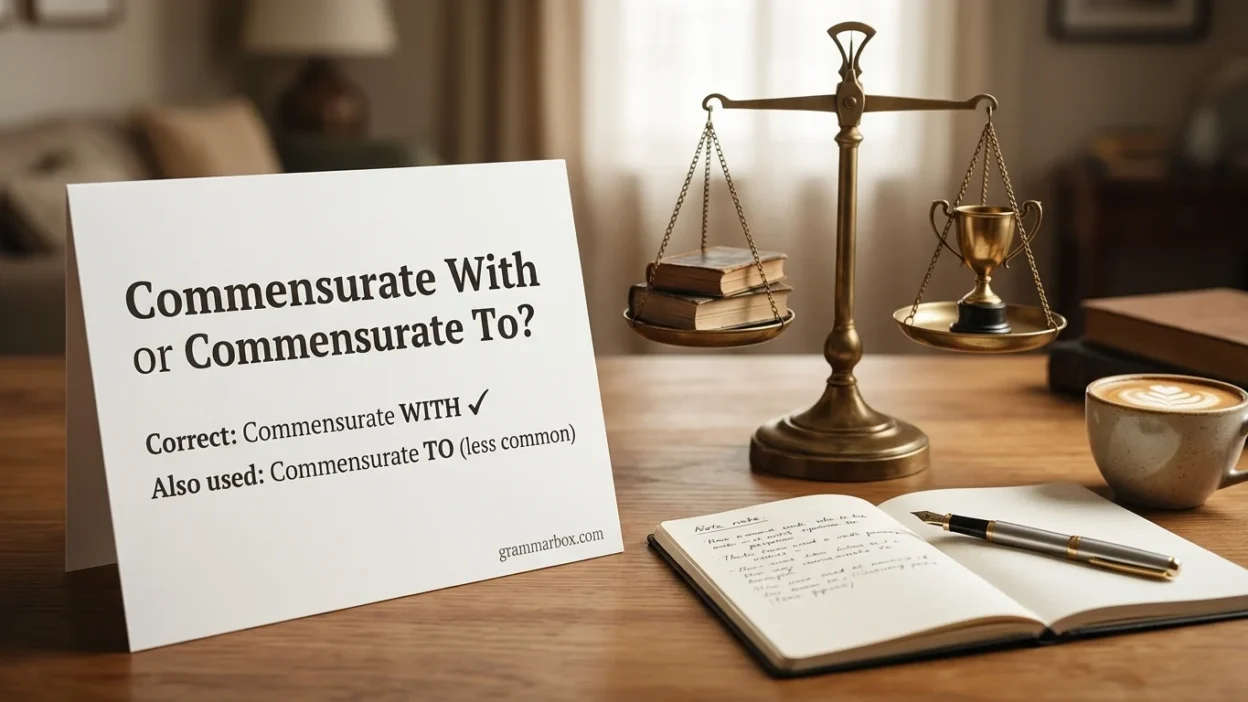
“Commensurate with” is the standard and widely accepted expression in modern English. It means equal, corresponding, or proportionate to something. For example, “Your salary should be commensurate with your experience.” Although “commensurate to” occasionally appears, it is generally less idiomatic.
Why People Confuse It
People often confuse commensurate with and commensurate to because the adjective commensurate expresses a relationship involving comparison, equality, or proportion.
Since English speakers commonly use the preposition to after words such as equal, similar, and proportional, they may assume that the same construction works with commensurate.
Another reason is that both prepositions can express relationships between two things. However, English prepositions do not always follow predictable patterns.
Consider these examples:
- Correct: Your compensation should be commensurate with your responsibilities.
- Less idiomatic: Your compensation should be commensurate to your responsibilities.
The first construction is the conventional choice in standard English.
First Word: Commensurate With
Commensurate with is the preferred expression when describing something that corresponds appropriately in size, amount, degree, value, or importance to something else.
It indicates that two things are proportionate or suitably matched.
Meaning:
- Equal or corresponding in measure.
- Proportionate to something.
- Appropriate in relation to another thing.
- Matching in degree, value, or importance.
Examples:
- Her salary is commensurate with her experience.
- The responsibilities should be commensurate with the position.
- His punishment was commensurate with the seriousness of the offense.
- The reward was commensurate with the effort required.
- Employees expect benefits commensurate with their qualifications.
- The price should be commensurate with the product’s quality.
- The investment must be commensurate with the expected returns.
- Her achievements are commensurate with her dedication.
- The level of risk should be commensurate with the potential benefits.
- The compensation package is commensurate with industry standards.
When to use it:
Use commensurate with when comparing two things and showing that their amounts, levels, or qualities appropriately correspond.
It is especially common in:
- Business communication.
- Employment advertisements.
- Academic writing.
- Legal documents.
- Financial discussions.
- Professional evaluations.
Second Word: Commensurate To
Commensurate to is occasionally encountered, but it is not the conventional prepositional construction in standard modern English.
Writers sometimes choose to because they associate the word commensurate with expressions such as proportional to or equal to.
However, the established collocation is commensurate with.
Examples of less idiomatic usage:
- The salary is commensurate to his experience.
- The punishment should be commensurate to the crime.
- Her responsibilities are commensurate to her position.
- The reward was commensurate to their efforts.
- The investment is commensurate to the expected return.
Better alternatives:
- The salary is commensurate with his experience.
- The punishment should be commensurate with the crime.
- Her responsibilities are commensurate with her position.
- The reward was commensurate with their efforts.
- The investment is commensurate with the expected return.
Is commensurate to always grammatically wrong?
It is better described as a nonstandard or less idiomatic alternative rather than the preferred expression. In formal and professional writing, choose commensurate with to ensure natural, conventional usage.
Comparison Table
| Feature | Commensurate With | Commensurate To |
|---|---|---|
| Standard usage | Preferred | Less established |
| Grammar | Conventional | Less idiomatic |
| Meaning | Proportionate or corresponding | Intended to express a similar relationship |
| Formal writing | Recommended | Generally avoided |
| Professional communication | Natural | Awkward to many readers |
| Commonness | Widely used | Relatively uncommon |
| Example | Commensurate with experience | Commensurate to experience |
The winner: Commensurate with is the safest and most natural choice in modern standard English.
When to Use Each
Understanding the context can help you choose the right construction.
Use Commensurate With for Comparisons
When discussing salaries, qualifications, responsibilities, or rewards, use commensurate with.
Examples:
- The salary should be commensurate with your qualifications.
- His authority is commensurate with his responsibilities.
- The benefits are commensurate with the position.
Use Commensurate With in Formal Writing
In academic papers, business reports, and official documents, the established expression is preferable.
Examples:
- The findings are commensurate with the available evidence.
- The funding should be commensurate with the project’s requirements.
- The proposed measures are commensurate with the identified risks.
Avoid Commensurate To in Standard Writing
Although readers may understand what you mean, this construction can sound unnatural.
Instead of writing:
– The payment is commensurate to the work.
Write:
– The payment is commensurate with the work.
The revised sentence follows conventional English usage.
Examples of Commensurate With and Commensurate To
Here are 12 additional examples to help you understand the difference.
| Less Preferred | Recommended |
|---|---|
| His pay is commensurate to his experience. | His pay is commensurate with his experience. |
| The reward is commensurate to the effort. | The reward is commensurate with the effort. |
| The punishment is commensurate to the offense. | The punishment is commensurate with the offense. |
| Her duties are commensurate to her position. | Her duties are commensurate with her position. |
| The cost is commensurate to the quality. | The cost is commensurate with the quality. |
| The benefits are commensurate to the risks. | The benefits are commensurate with the risks. |
More natural example sentences:
- A higher salary should be commensurate with additional responsibilities.
- The compensation is commensurate with the employee’s experience.
- The consequences should be commensurate with the offense.
- His recognition was commensurate with his achievements.
- The company’s investment was commensurate with its ambitions.
- The resources allocated should be commensurate with the project’s scale.
Common Mistakes
Even experienced English writers sometimes misuse prepositions. Here are some mistakes to avoid.
1. Using to instead of with
Incorrect: The salary is commensurate to your experience.
Correct: The salary is commensurate with your experience.
2. Confusing commensurate with proportional
Both words express relationships involving proportion, but their usual prepositions differ.
- Commensurate with the workload.
- Proportional to the workload.
3. Using commensurate when describing unrelated things
The word implies a meaningful relationship between two things.
Unnatural: The weather is commensurate with the book.
Natural: The salary is commensurate with the employee’s experience.
4. Forgetting the preposition
Incorrect: Her salary is commensurate her qualifications.
Correct: Her salary is commensurate with her qualifications.
5. Using commensurate when equal is more appropriate
Sometimes, simpler words communicate your meaning more clearly.
Instead of saying, “The two amounts are commensurate with each other,” you could say, “The two amounts are equivalent.”
Memory Trick
Remember this simple trick:
Commensurate WITH = Corresponding WITH something.
Think of the word with as connecting two things that match in proportion, value, or degree.
For example:
- Salary with experience.
- Responsibility with authority.
- Reward with effort.
- Punishment with offense.
Whenever you use commensurate to describe a proportional relationship, remember to use with.
American vs British English
There is no meaningful difference between American and British English regarding the standard use of commensurate with.
Both varieties generally prefer this construction in formal and everyday professional writing.
| Feature | American English | British English |
|---|---|---|
| Preferred phrase | Commensurate with | Commensurate with |
| Meaning | Proportionate or corresponding | Proportionate or corresponding |
| Commensurate to | Less idiomatic | Less idiomatic |
| Formal usage | Commensurate with | Commensurate with |
American English example:
The compensation should be commensurate with your qualifications.
British English example:
The remuneration should be commensurate with your qualifications.
Notice that compensation and remuneration are different vocabulary choices, but the preposition remains the same.
Similar Words
Several English words have meanings similar to commensurate. However, their grammatical patterns may differ.
| Word | Meaning | Correct Construction |
|---|---|---|
| Proportional | Corresponding in proportion | Proportional to |
| Equivalent | Equal in value or meaning | Equivalent to |
| Proportionate | Corresponding appropriately in degree | Proportionate to |
| Comparable | Similar enough to compare | Comparable to/with |
| Corresponding | Matching or related | Corresponding to |
| Consistent | In agreement with something | Consistent with |
| Equivalent | Having the same value | Equivalent to |
Example sentences:
- Your salary should be proportional to your experience.
- This product is equivalent to the original.
- The punishment should be proportionate to the offense.
- Her performance is comparable to that of other employees.
- The results are consistent with previous research.
Learning these expressions can improve your vocabulary and help you choose the correct preposition in formal English.
FAQs:
1. Is it commensurate with or commensurate to?
Commensurate with is the standard and preferred expression. It means proportionate or corresponding to something in amount, value, or degree.
2. What does commensurate with mean?
It means equal, appropriate, or proportionate in relation to something else. For example, a salary commensurate with experience means compensation that appropriately reflects someone’s experience.
3. Is commensurate to grammatically correct?
It is occasionally used, but it is less idiomatic than commensurate with. For standard English writing, commensurate with is the recommended construction.
4. Can I use commensurate with in professional writing?
Yes. It is particularly common in job advertisements, employment contracts, business reports, and discussions about salaries and responsibilities.
5. What is another word for commensurate?
Depending on the context, you can use proportionate, equivalent, corresponding, comparable, or matching.
6. Is commensurate with used in American and British English?
Yes. Both American and British English use commensurate with as the conventional expression. There is no significant regional difference in this grammatical pattern.
7. What is an example of commensurate with in a sentence?
“Your compensation should be commensurate with your qualifications and professional experience.” This means your payment should appropriately reflect your skills and experience.
Final Verdict
When deciding between commensurate with and commensurate to, choose commensurate with. It is the established expression in standard modern English and is suitable for academic, professional, and everyday formal communication. It describes a relationship in which two things correspond appropriately in amount, value, importance, or degree.
Although you might encounter commensurate to in some writing, it is generally less natural and should be avoided when a conventional alternative is available. Remembering this simple preposition choice will make your sentences clearer and help you communicate more confidently.
Remember This
- Commensurate with: The standard and recommended expression.
- Commensurate to: Less idiomatic and generally avoided.
- Meaning: Proportionate, corresponding, or appropriately matched.
- Example: Your salary should be commensurate with your experience.
The easiest way to remember the rule is: Always prefer commensurate with in standard English.
Conclusion
Choosing the correct preposition is an important part of improving your English grammar. Although commensurate with and commensurate to may appear similar, the former is the established expression used by proficient English writers. It helps describe relationships involving salaries, responsibilities, qualifications, rewards, and other proportional comparisons.
For your next academic assignment, professional email, or business document, remember to write commensurate with. Understanding this small grammatical distinction can make your writing more natural, accurate, and professional.