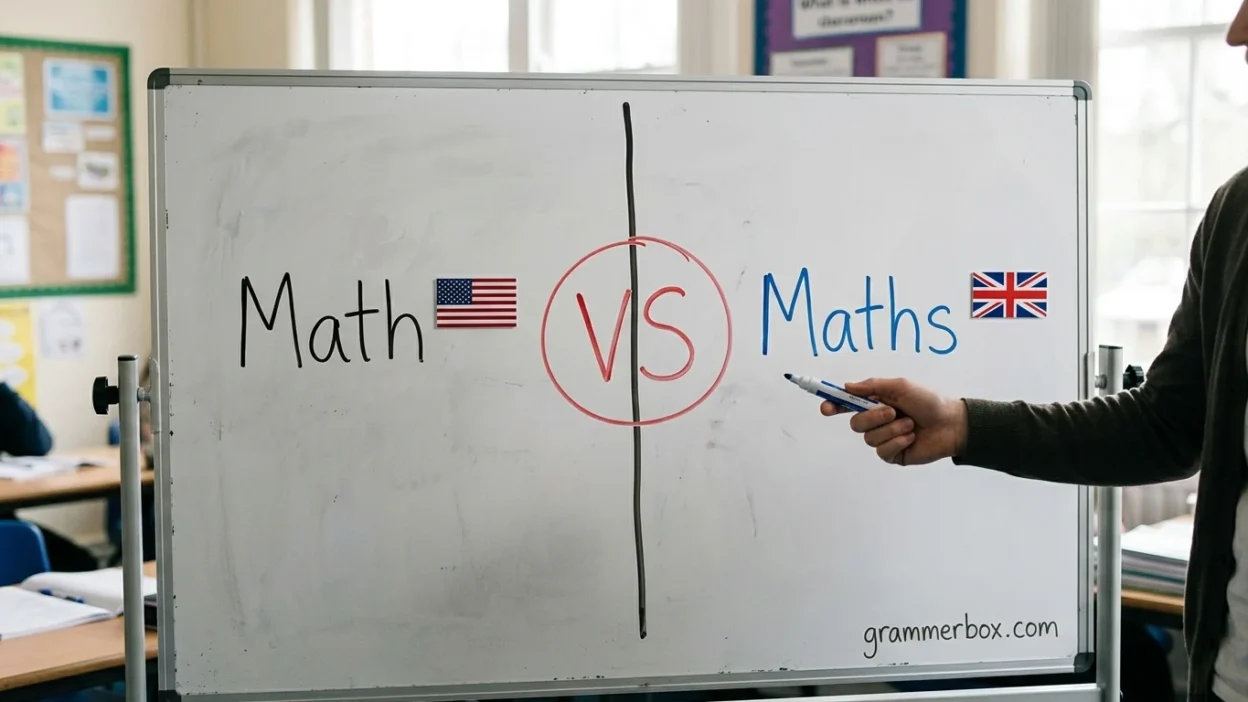
The words math vs maths often confuse English learners because both refer to the same school subject: mathematics. However, the word people use depends largely on where they live and which variety of English they speak. In the United States, people generally say math, while in the United Kingdom, Australia, and several other English-speaking countries, maths is the preferred form.
Although these words look slightly different, their meanings are almost identical. Neither is grammatically incorrect, and both are widely accepted in their respective regions. Understanding the difference can help you choose the right word for academic writing, everyday conversations, school assignments, and professional communication. In this guide, we will explain the meanings of math and maths, compare their usage, explore American and British English preferences, and provide practical examples to help you use each word confidently.
Quick Answer
Math is the common American English abbreviation for mathematics, while maths is preferred in British, Australian, and other varieties of English. Both words have the same meaning and refer to the subject involving numbers, calculations, shapes, and mathematical principles.
Why People Confuse Math and Maths
People often confuse math and maths because both words are abbreviations of the same longer word, mathematics.
The main reason for the difference is regional language preference. American English uses math, whereas British English generally uses maths.
Here are three reasons why these words cause confusion:
- Different regional preferences: Americans say math, while British speakers commonly say maths.
- Similar meanings: Both words refer to the same academic subject.
- Different abbreviation styles: The American abbreviation drops the ending, while the British abbreviation retains the final s.
For English learners, the difference can be especially confusing because both versions appear in textbooks, websites, educational videos, and international publications.
Math
Math is the shortened form of mathematics commonly used in American English. It refers to the academic subject that deals with numbers, measurements, calculations, equations, and logical reasoning.
It is a noun and can be used in everyday conversations, educational settings, and formal writing.
Examples of Math in Sentences:
- I have a math exam tomorrow.
- She enjoys solving difficult math problems.
- My brother is studying math at university.
- Math was my favorite subject in school.
- The teacher explained the math formula clearly.
- He needs extra help with math homework.
- I find advanced math challenging.
- Our school offers several math courses.
- She wants to become a math teacher.
- Learning math helps develop problem-solving skills.
Common Expressions with Math:
- Math class
- Math homework
- Math teacher
- Math problems
- Math skills
- Math textbook
- Math equation
- Math competition
In American English, math is the natural and standard choice in both casual and educational contexts.
Maths
Maths is the shortened form of mathematics commonly used in British English. It has exactly the same meaning as math and refers to the study of numbers, calculations, measurements, and mathematical concepts.
The additional s does not change the meaning or grammatical function of the word.
Examples of Maths in Sentences:
- I have a maths exam tomorrow.
- She enjoys solving difficult maths problems.
- My brother is studying maths at university.
- Maths was my favorite subject in school.
- The teacher explained the maths formula clearly.
- He needs extra help with his maths homework.
- I find advanced maths challenging.
- Our school offers several maths courses.
- She wants to become a maths teacher.
- Learning maths improves problem-solving skills.
Common Expressions with Maths:
- Maths class
- Maths homework
- Maths teacher
- Maths problems
- Maths skills
- Maths textbook
- Maths equation
- Maths competition
In British English, maths is the natural choice for conversations, educational materials, and formal writing.
Math vs Maths: Comparison Table
The following table highlights the main differences between math and maths.
| Feature | Math | Maths |
|---|---|---|
| Meaning | Mathematics | Mathematics |
| Word type | Noun | Noun |
| Regional usage | American English | British English |
| Pronunciation | /mæθ/ | /mæθs/ |
| Full form | Mathematics | Mathematics |
| Meaning difference | None | None |
| Common in | United States | UK, Australia |
| Correctness | Correct | Correct |
| Example | Math class | Maths class |
The important point is that both words are correct. Your choice depends on your target audience and the variety of English you are using.
When to Use Each
Choosing between math and maths is simple once you understand their regional differences.
When to Use Math
Use math when writing or speaking in American English.
It is appropriate for:
- American school assignments.
- US-based educational websites.
- Conversations with American English speakers.
- American academic publications.
- Content targeting readers in the United States.
Example: My daughter loves math and wants to study engineering.
When to Use Maths
Use maths when writing or speaking in British English.
It is appropriate for:
- British school assignments.
- UK-based educational websites.
- Conversations with British English speakers.
- Australian educational materials.
- Publications following British English conventions.
Example: My daughter loves maths and wants to study engineering.
Can You Use Both Words?
Yes. Both forms are correct, but it is better to remain consistent throughout a document.
For example, if your article follows American English, use math consistently. If it follows British English, use maths.
Examples of Math vs Maths in Sentences
Here are 12 examples showing how both words work in everyday English.
| American English (Math) | British English (Maths) |
|---|---|
| I love math. | I love maths. |
| Math is difficult for me. | Maths is difficult for me. |
| She teaches math. | She teaches maths. |
| I need a math book. | I need a maths book. |
| My math exam is tomorrow. | My maths exam is tomorrow. |
| He studies math every day. | He studies maths every day. |
| Math helps develop logical thinking. | Maths helps develop logical thinking. |
| We have math homework. | We have maths homework. |
| She is good at math. | She is good at maths. |
| Math is an important subject. | Maths is an important subject. |
| I enjoy learning math. | I enjoy learning maths. |
| He wants to become a math teacher. | He wants to become a maths teacher. |
Notice: The sentences have identical meanings. Only the regional spelling and usage preference change.
Common Mistakes
Although math and maths are both correct, English learners sometimes make mistakes when using them.
Here are some common mistakes to avoid:
1. Thinking Math Is Incorrect in British English
Math is an American English abbreviation, but it is understandable internationally. However, maths is the more traditional British form.
2. Thinking Maths Is Incorrect in American English
Maths is not a spelling mistake. It is simply less common in American English.
3. Using Both Forms Randomly
Avoid switching between math and maths in the same article or academic document. Follow one English variety consistently.
4. Thinking the Words Have Different Meanings
Both words refer to mathematics. The additional s does not create a different subject or concept.
5. Adding an Unnecessary Plural Ending
Avoid writing maths subjects when you mean the academic subject generally. Use the expression that fits your intended meaning.
6. Assuming Maths Is Always Plural
Although maths ends in s, it is generally treated as a singular subject name.
Example:
- Correct: Maths is my favorite subject.
- Incorrect: Maths are my favorite subject.
Memory Trick: How to Remember Math vs Maths
A simple memory trick can help you remember which version to use.
- Math = America: Both words are shorter and have no additional s.
- Maths = British English: Remember the extra s in maths when using British English.
Another easy way to remember:
USA = Math
UK = Maths
Whenever you are unsure, think about your target audience. If you are writing for American readers, choose math. For British readers, choose maths.
American vs British English: Math vs Maths
The difference between math and maths is a well-known example of American and British English vocabulary variation.
In the United States, math is the standard abbreviation for mathematics. American schools, universities, teachers, and educational websites commonly use this form.
In the United Kingdom, maths is the preferred abbreviation. The same preference is also found in countries such as Australia and New Zealand.
Here is a quick regional overview:
| Country or Region | Preferred Form |
|---|---|
| United States | Math |
| United Kingdom | Maths |
| Australia | Maths |
| New Zealand | Maths |
| Canada | Math (commonly) |
| Ireland | Maths |
| South Africa | Maths (commonly) |
These are general preferences rather than absolute rules. Individual speakers and publications may vary.
If you are creating educational content for an international audience, you can mention both versions while choosing one as your primary style.
Similar Words
Math vs maths is not the only example of differences between American and British English. Several other words also have different regional forms.
Here are some related examples:
| American English | British English |
|---|---|
| Color | Colour |
| Favorite | Favourite |
| Center | Centre |
| Theater | Theatre |
| Organize | Organise |
| Analyze | Analyse |
| Traveling | Travelling |
| Check | Cheque (payment) |
| Gray | Grey |
| Math | Maths |
Learning these differences can improve your spelling, vocabulary, and understanding of international English.
FAQs:
1. Is Math or Maths Correct?
Both math and maths are correct. Math is the standard American English form, while maths is preferred in British English and several other English-speaking countries.
2. Why Do Americans Say Math Instead of Maths?
Americans commonly use math as a shortened form of mathematics. This abbreviation became the standard American English preference, while British English retained the additional s.
3. Is Maths British or American English?
Maths is primarily associated with British English. It is also commonly used in Australia, New Zealand, Ireland, and other countries that follow British English conventions.
4. Is Math Singular or Plural?
Math is generally treated as a singular noun when referring to the academic subject.
Example: Math is an interesting subject.
5. Is Maths Singular or Plural?
Despite ending in s, maths is generally treated as a singular noun when referring to the school subject.
Example: Maths is my favorite subject.
6. Do Canadians Say Math or Maths?
Canadians generally use math, following the American English preference. However, individual usage can vary.
7. Should I Write Math or Maths in Academic Writing?
Choose the form that matches your institution’s or publication’s preferred English style. Use math for American English and maths for British English, and remain consistent throughout your writing.
Final Verdict: Math vs Maths
The difference between math vs maths is mainly regional, not grammatical or semantic. Both words are abbreviations of mathematics and describe the same academic subject. Math is preferred in American English, whereas maths is the standard choice in British English and commonly used in Australia and New Zealand.
When choosing between them, consider your audience and writing style. If you are preparing content for American readers, use math. If your audience follows British English, choose maths. Most importantly, remember that neither spelling is wrong. Both are accepted English forms with the same meaning.
Remember This
- Math: American English abbreviation of mathematics.
- Maths: British English abbreviation of mathematics.
- Meaning: Both words refer to the same academic subject.
- Grammar: Both are generally treated as singular nouns.
- Best Tip: Choose the version that matches your audience and use it consistently.
Conclusion
Understanding math vs maths is easy once you know the difference between American and British English. Both words have the same meaning, and neither is incorrect. The only real difference is regional preference, with Americans generally choosing math and British speakers preferring maths.
If you are writing an educational article, completing schoolwork, or improving your English vocabulary, choosing the appropriate version will make your writing sound more natural. Remember the simple rule: use math for American English and maths for British English.