Have you ever wondered if to write swept or sweeped when talking about something you cleaned in the past? You are not alone. Many English learners and even native speakers find this verb confusing because regular English verbs usually form their past tense by adding “-ed.” However, some verbs follow different patterns, and sweep is one of them. Understanding its correct past tense can help you avoid common grammar mistakes in everyday writing and conversation.
The confusion between swept and sweeped often comes from applying regular verb rules to an irregular verb. Although both forms might look understandable, only one is accepted in standard modern English. Whether you are writing a school assignment, sending a professional email, or improving your English vocabulary, knowing the difference will make your sentences clearer. In this guide, you will learn the meaning of each form, the correct past tense of sweep, useful examples, and simple tricks to remember the right spelling.
Quick Answer: Swept vs Sweeped
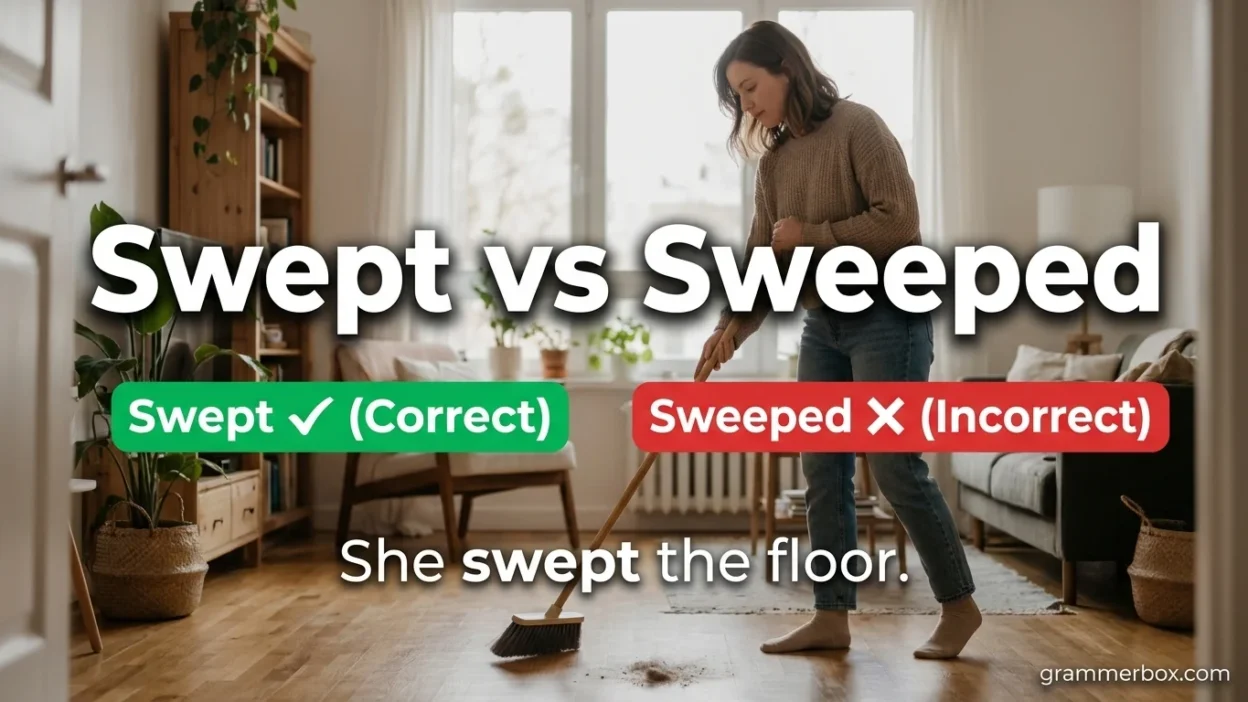
Swept is the correct simple past tense and past participle of the verb sweep. Sweeped is a nonstandard form and should generally be avoided in formal and everyday English. For example, “She swept the floor yesterday” is correct, while “She sweeped the floor yesterday” is incorrect.
Why People Confuse It
People confuse swept and sweeped because most regular English verbs form their past tense by adding “-ed.”
For example:
- Walk → Walked
- Clean → Cleaned
- Jump → Jumped
- Open → Opened
Following this familiar pattern, someone might naturally assume that sweep becomes sweeped.
However, sweep is an irregular verb, which means it changes its form instead of following the standard “-ed” rule.
Its correct verb forms are:
- Present: Sweep
- Simple past: Swept
- Past participle: Swept
The main thing to remember is that irregular verbs have their own past-tense patterns.
First Word: Swept
Swept is the correct past tense and past participle of the verb sweep. It means to clean or remove dirt, dust, or unwanted material using a broom or similar tool.
It can also describe something moving quickly across an area or a situation in which someone or something is carried away.
Examples of Swept in Sentences:
- She swept the kitchen floor before breakfast.
- He swept the leaves away from the front door.
- The wind swept dust across the empty road.
- My mother swept the living room yesterday.
- The storm swept through the coastal town.
- They swept the classroom after the lesson.
- The goalkeeper swept the ball away from danger.
- A wave of excitement swept through the crowd.
- The cleaner swept the hallway carefully.
- The firefighters swept the building for survivors.
When to Use Swept
Use swept when describing an action that happened in the past or when forming a perfect tense.
Examples:
- Simple past: I swept the garage this morning.
- Present perfect: She has swept the entire house.
- Past perfect: They had swept the floor before the guests arrived.
Swept is also used figuratively to describe something spreading or moving rapidly.
Example: A feeling of relief swept over everyone.
Second Word: Sweeped
Sweeped is a nonstandard and generally incorrect past-tense form of the verb sweep. It results from applying the regular verb rule of adding “-ed” to the original word.
Although people sometimes use sweeped in casual conversations or while learning English, it is not accepted as the standard past tense in modern English.
- She sweeped the kitchen yesterday.
- He has sweeped the entire room.
- They sweeped the leaves into a pile.
- My brother sweeped the garage.
- The cleaner sweeped the hallway.
Correct Alternatives:
- She swept the kitchen yesterday.
- He has swept the entire room.
- They swept the leaves into a pile.
- My brother swept the garage.
- The cleaner swept the hallway.
Why Is Sweeped Incorrect?
The verb sweep belongs to a group of irregular English verbs. Instead of adding “-ed,” it changes to swept.
This pattern is similar to other irregular verbs:
- Keep → Kept
- Sleep → Slept
- Weep → Wept
- Creep → Crept
Therefore, swept is the appropriate form to use in standard English.
Swept vs Sweeped: Comparison Table
| Feature | Swept | Sweeped |
|---|---|---|
| Correctness | Correct | Nonstandard |
| Verb type | Irregular | Incorrect regularization |
| Present form | Sweep | Sweep |
| Past tense | Swept | Sweeped |
| Past participle | Swept | Sweeped |
| Formal writing | Accepted | Avoid |
| Everyday English | Accepted | Incorrect in standard usage |
Quick tip: Whenever you need the past tense of sweep, choose swept rather than sweeped.
When to Use Each
Understanding when to use swept and sweeped is straightforward once you know that sweep is an irregular verb.
When to Use Swept
Use swept in all standard grammatical situations where the past tense or past participle of sweep is required.
1. For completed past actions
- She swept the floor last night.
- I swept the garden before dinner.
2. With helping verbs
- He has swept the entire house.
- They had swept the office before closing.
3. For figurative expressions
- Happiness swept through the audience.
- Fear swept across the village.
When to Avoid Sweeped
Avoid sweeped in standard English writing and speech.
For example:
Incorrect: The workers sweeped the street.
Correct: The workers swept the street.
Incorrect: She has sweeped the bedroom.
Correct: She has swept the bedroom.
Remember that sweeped does not become correct simply because you are using a regular past-tense pattern.
Examples of Swept vs Sweeped in Sentences
Here are 15 examples to help you understand the correct usage.
| Incorrect (Sweeped) | Correct (Swept) |
|---|---|
| She sweeped the floor. | She swept the floor. |
| He sweeped the kitchen. | He swept the kitchen. |
| They sweeped the street. | They swept the street. |
| I sweeped the garage. | I swept the garage. |
| We sweeped the classroom. | We swept the classroom. |
| The wind sweeped the leaves away. | The wind swept the leaves away. |
| My father sweeped the porch. | My father swept the porch. |
| She has sweeped the room. | She has swept the room. |
| They had sweeped the hall. | They had swept the hall. |
| The storm sweeped across the land. | The storm swept across the land. |
Additional Correct Examples:
11. The team swept the competition with an impressive performance.
12. A sudden feeling of sadness swept over him.
13. The nurse swept the room before the patients arrived.
14. The river swept away several fallen branches.
15. The cleaning staff had swept the floors before opening time.
These examples show that swept can describe both physical cleaning and figurative movement.
Common Mistakes
English learners often make a few predictable mistakes when using the verb sweep.
Here are some common errors and their corrections.
1. Using Sweeped as the Past Tense
Incorrect: I sweeped the floor yesterday.
Correct: I swept the floor yesterday.
2. Using Sweeped with Has or Have
Incorrect: She has sweeped the kitchen.
Correct: She has swept the kitchen.
3. Confusing Sweep and Swept
Incorrect: He swept the floor every morning. (When describing a regular present habit.)
Correct: He sweeps the floor every morning.
4. Forgetting the Past Participle
Incorrect: They have sweep the room.
Correct: They have swept the room.
5. Applying Regular Verb Rules to Irregular Verbs
Incorrect: He sweeped the leaves outside.
Correct: He swept the leaves outside.
The best way to avoid these mistakes is to learn irregular verbs in groups and practice their different forms.
Memory Trick: How to Remember Swept
Here is an easy trick to remember the correct past tense of sweep.
Think of this simple pattern:
Sweep → Swept → Swept
You can also remember that sweep rhymes with several verbs that change their spelling in a similar way:
- Keep → Kept
- Sleep → Slept
- Weep → Wept
- Sweep → Swept
Notice that these verbs replace their ending with a “t” sound rather than adding “-ed.”
Easy Memory Sentence:
“I sweep today, but I swept yesterday.”
This short sentence helps you remember the difference between the present and past forms.
American vs British English
There is no difference between American and British English when it comes to swept and sweeped.
Both varieties use swept as the correct past tense and past participle of sweep.
| English Variety | Correct Form | Incorrect Form |
|---|---|---|
| American English | Swept | Sweeped |
| British English | Swept | Sweeped |
| Canadian English | Swept | Sweeped |
| Australian English | Swept | Sweeped |
For example:
- American English: She swept the kitchen floor.
- British English: She swept the kitchen floor.
The spelling and grammatical usage remain the same across these varieties.
Therefore, you do not need to worry about regional spelling differences when choosing between swept and sweeped.
Similar Words
Learning other irregular verbs can help you understand why swept is correct.
Here are some verbs with similar past-tense patterns.
| Present Tense | Past Tense | Past Participle |
|---|---|---|
| Sweep | Swept | Swept |
| Keep | Kept | Kept |
| Sleep | Slept | Slept |
| Weep | Wept | Wept |
| Creep | Crept | Crept |
| Feel | Felt | Felt |
| Leave | Left | Left |
| Deal | Dealt | Dealt |
| Meet | Met | Met |
| Sleep | Slept | Slept |
These verbs demonstrate that English has several irregular verb patterns.
You may also encounter these related words:
- Sweeper: A person or machine that cleans an area by sweeping.
- Sweeping: The act of cleaning with a broom.
- Sweep: The present-tense verb describing the cleaning action.
- Swept away: A phrase describing something carried away by a force or emotion.
Learning these related forms can expand your vocabulary and improve your understanding of English grammar.
FAQs:
1. Is swept or sweeped correct?
Swept is correct. It is the standard simple past tense and past participle of the irregular verb sweep. Sweeped is a nonstandard form and should be avoided in standard English.
2. What is the past tense of sweep?
The past tense of sweep is swept.
Example: She swept the floor before going to work.
3. Is sweeped a real word?
Sweeped is sometimes encountered as a nonstandard form created by applying regular past-tense rules. However, it is not accepted as the standard past tense of sweep.
4. Is swept a past tense or past participle?
Swept is both the simple past tense and the past participle of sweep.
Examples:
- Past tense: He swept the room.
- Past participle: He has swept the room.
5. Why does sweep become swept instead of sweeped?
Sweep is an irregular verb, meaning it does not follow the regular rule of adding “-ed” to form the past tense. Its established past-tense form is swept.
6. Is it has swept or has sweeped?
Has swept is correct because swept is the past participle of sweep.
Example: She has swept the entire house.
7. Do Americans and British people use swept differently?
No. Both American and British English use swept as the correct past tense and past participle. Neither variety uses sweeped as the standard form.
Final Verdict
The difference between swept and sweeped is simple: swept is correct, while sweeped is nonstandard. Swept is the simple past tense and past participle of the irregular verb sweep. It works in sentences about cleaning floors, removing leaves, or describing something moving rapidly across an area.
Whenever you are unsure which form to choose, remember that sweep follows an irregular verb pattern similar to keep and sleep. Instead of adding “-ed,” its spelling changes to swept. Using the correct form will make your English writing more natural, accurate, and professional.
Remember This
Sweep → Swept → Swept
- Sweep: Present tense
- Swept: Simple past tense
- Swept: Past participle
- Sweeped: Nonstandard form; avoid it.Correct: I swept the floor yesterday.