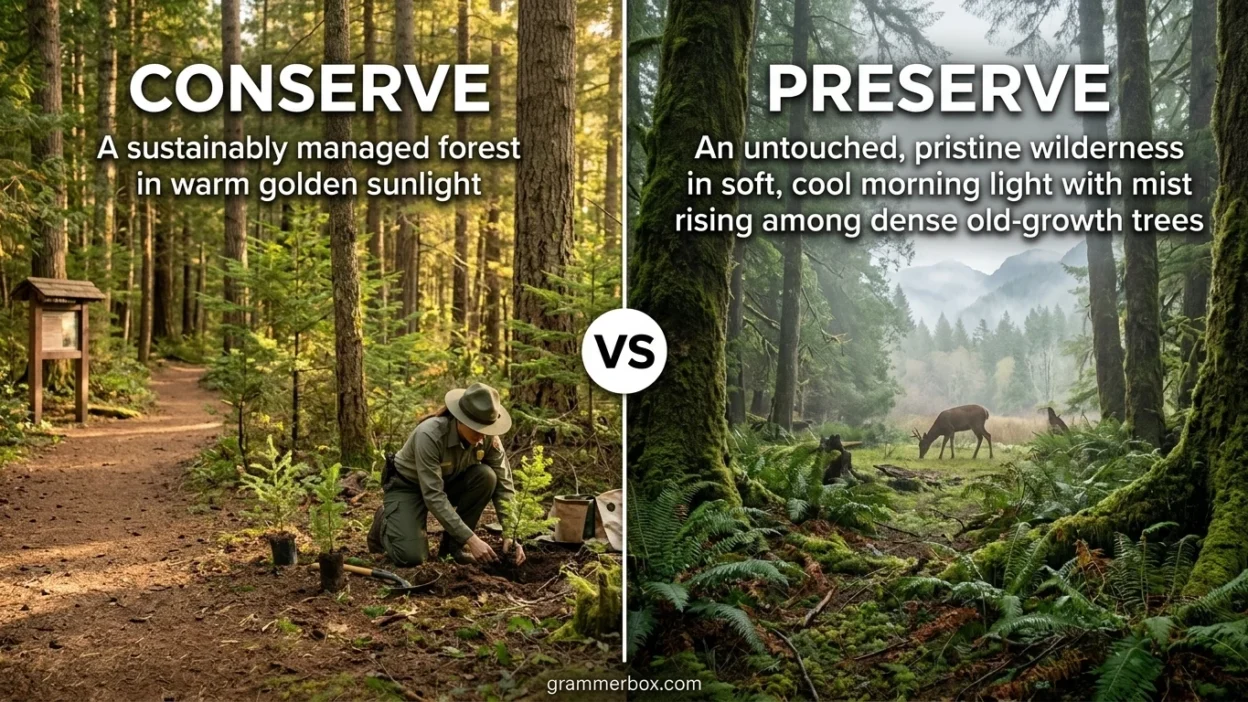
The words conserve and preserve are closely related because both describe actions that protect something valuable. However, they are not interchangeable in every situation. If you are talking about natural resources, historical buildings, wildlife, energy, or food, choosing the correct word can make your sentence clearer and more accurate. Understanding the difference between conserve vs. preserve will help you communicate your ideas more effectively.
Although both words involve protection, they emphasize different approaches. Conserve generally means using something carefully to prevent waste or depletion, while preserve means keeping something safe, unchanged, or in its original condition. For example, we conserve water by avoiding unnecessary use, but we preserve historical documents by protecting them from damage. Learning when to use each word will improve your vocabulary, writing, and everyday English.
Quick Answer: Conserve vs. Preserve
Conserve means to use something carefully and avoid wasting it, especially natural resources, energy, or money. Preserve means to protect something from damage, loss, or change so it can remain in good condition. In short, conserve focuses on careful use, while preserve focuses on protection and maintaining something.
Why People Confuse Conserve and Preserve
People often confuse conserve and preserve because both words describe protecting valuable things. They frequently appear in similar discussions about environmental protection, wildlife, natural resources, and historical sites.
However, their meanings have slightly different focuses:
- Conserve: Emphasizes careful use, saving, and preventing waste.
- Preserve: Emphasizes protection, maintenance, and preventing damage or change.
For example:
- We should conserve electricity by turning off unused lights.
- We should preserve historic buildings for future generations.
In the first sentence, the goal is to reduce electricity consumption. In the second, the goal is to protect buildings from damage or destruction.
Understanding this distinction makes it easier to choose the right word in different contexts.
First Word: Conserve
Conserve is a verb that means to use something carefully, avoid unnecessary waste, or protect it from being used up.
It is commonly used when discussing limited resources that people need to manage responsibly. These resources may include water, energy, fuel, money, forests, and wildlife populations.
Definition of Conserve
According to its general English meaning, conserve refers to protecting something by using it wisely or managing it carefully to prevent loss or depletion.
Examples:
- We must conserve water during the dry season.
- Turning off unnecessary lights helps conserve electricity.
- Families can conserve money by avoiding unnecessary purchases.
- The government introduced new policies to conserve natural resources.
- Farmers use modern irrigation systems to conserve water.
- We should conserve energy to reduce environmental pollution.
- The organization works to conserve endangered wildlife.
- People can conserve fuel by using public transportation.
When Is Conserve Used?
Use conserve when discussing:
- Natural resources: Conserving water, forests, soil, and minerals.
- Energy: Conserving electricity, fuel, and other energy sources.
- Money: Conserving financial resources and reducing unnecessary expenses.
- Wildlife: Managing animal populations and protecting biodiversity.
- Food: Conserving supplies and avoiding unnecessary waste.
Example: People should conserve natural resources because many of them are limited.
Second Word: Preserve
Preserve is a verb that means to protect something from damage, destruction, decay, or unwanted change.
It is commonly used when something valuable needs to remain safe, maintain its original condition, or continue to exist for the future.
Definition of Preserve
Preserve generally means keeping something in its existing or original state by protecting it from harm, loss, or deterioration.
Examples:
- We should preserve historical buildings for future generations.
- Refrigeration helps preserve fresh food.
- The museum works hard to preserve ancient artifacts.
- Families often preserve traditional recipes.
- The government created a park to preserve natural habitats.
- These photographs help preserve important family memories.
- Scientists are working to preserve endangered plant species.
- We must preserve our cultural heritage.
When Is Preserve Used?
Use preserve when discussing:
- Historical sites: Preserving monuments, buildings, and archaeological discoveries.
- Culture: Preserving traditions, languages, and customs.
- Food: Preserving fruits, vegetables, and other perishable items.
- Nature: Preserving ecosystems, habitats, and biodiversity.
- Memories: Preserving photographs, records, and personal experiences.
- Original conditions: Preserving the appearance or quality of something.
Example: The community wants to preserve its cultural traditions for future generations.
Conserve vs. Preserve: Comparison Table
Although conserve and preserve share a similar idea of protection, their meanings, purposes, and common applications are different.
| Feature | Conserve | Preserve |
|---|---|---|
| Part of speech | Verb | Verb |
| Main meaning | Use carefully and avoid waste | Protect from damage or change |
| Main focus | Efficient use | Long-term protection |
| Common objects | Water, energy, money | Buildings, traditions, memories |
| Purpose | Prevent depletion | Prevent damage or loss |
| Environmental use | Manage natural resources wisely | Protect habitats and ecosystems |
| Example | Conserve electricity | Preserve historical monuments |
| Related noun | Conservation | Preservation |
Simple distinction: You conserve something by managing its use carefully, but you preserve something by protecting it from harm or unwanted change.
When to Use Each: Conserve or Preserve?
Choosing between conserve and preserve depends on what you want to communicate. Here are some common situations that make the distinction easier.
1. Use Conserve for Natural Resources
When discussing limited resources that people consume, conserve is usually the better choice.
Examples:
- We need to conserve drinking water.
- The factory introduced new methods to conserve energy.
- Everyone should conserve natural resources.
2. Use Preserve for Historical Objects
When protecting something valuable from damage or destruction, use preserve.
Examples:
- The city plans to preserve its ancient architecture.
- Museums preserve valuable historical documents.
- We should preserve old photographs.
3. Use Conserve for Reducing Waste
Conserve is appropriate when your goal is to avoid unnecessary consumption.
Examples:
- Turn off the tap to conserve water.
- Using public transportation helps conserve fuel.
- Businesses should conserve financial resources.
4. Use Preserve for Maintaining Traditions
Preserve is generally more suitable when discussing customs, languages, cultural practices, and traditions.
Examples:
- Families preserve traditional recipes.
- Schools help preserve local languages.
- Communities work together to preserve their cultural heritage.
5. Use Both for Environmental Protection
Both words can describe environmental protection, but they communicate different approaches.
Examples:
- We must conserve water to reduce unnecessary consumption.
- We must preserve wetlands to protect their natural ecosystems.
Examples of Conserve vs. Preserve in Sentences
The following examples demonstrate how to use both words correctly in everyday English.
Conserve Examples
- We should conserve water because clean drinking water is a limited resource.
- The school encourages students to conserve electricity.
- Farmers need better irrigation systems to conserve water.
- You can conserve money by preparing meals at home.
- The organization launched a campaign to conserve endangered wildlife populations.
- Modern vehicles are designed to conserve fuel.
- Everyone has a responsibility to conserve natural resources.
- Planting trees can help conserve soil and reduce erosion.
- The company changed its production methods to conserve energy.
- We should conserve food instead of throwing away unnecessary leftovers.
Preserve Examples
- The government wants to preserve the country’s historical monuments.
- Refrigerators help preserve food for longer periods.
- We should preserve our cultural traditions.
- The museum works to preserve ancient paintings.
- The community wants to preserve its local language.
- These old letters preserve memories of previous generations.
- National parks help preserve natural habitats.
- The organization is working to preserve endangered plant species.
- Parents often preserve family photographs for their children.
- Scientists are developing methods to preserve important historical records.
Examples Using Both Words
- We conserve water and preserve clean rivers.
- Farmers conserve soil while communities preserve natural landscapes.
- People can conserve energy and preserve the environment.
- Governments should conserve forests and preserve endangered species.
- We must conserve resources while preserving our cultural heritage.
Common Mistakes When Using Conserve and Preserve
Even fluent English speakers sometimes use these words incorrectly because their meanings overlap.
Here are some mistakes worth avoiding.
Mistake 1: Treating Both Words as Exact Synonyms
Although both words involve protection, they do not always communicate the same idea.
- Incorrect for the intended meaning: We should preserve electricity by turning off unused lights.
- Better: We should conserve electricity by turning off unused lights.
Conserve is more natural because the sentence focuses on reducing electricity consumption.
Mistake 2: Using Conserve for Historical Buildings
When discussing protection from physical damage or destruction, preserve is generally more appropriate.
- Less natural: The community wants to conserve its ancient buildings.
- Better: The community wants to preserve its ancient buildings.
Conserve is not necessarily grammatically wrong here, but preserve better communicates the intended meaning.
Mistake 3: Using Preserve When You Mean Avoiding Waste
When talking about reducing the consumption of limited resources, conserve is usually preferable.
- Less precise: We should preserve water by taking shorter showers.
- Better: We should conserve water by taking shorter showers.
Mistake 4: Forgetting Their Different Noun Forms
The noun forms are also different:
- Conserve → Conservation
- Preserve → Preservation
Examples:
- Water conservation helps reduce unnecessary consumption.
- Historical preservation protects valuable buildings and monuments.
Remember that conservation and preservation have related but distinct meanings.
Memory Trick: How to Remember Conserve vs. Preserve
A simple memory trick can help you remember the difference without checking a dictionary every time.
Conserve = Careful Consumption
Think of conserving water, electricity, fuel, and money. You use these things carefully instead of wasting them.
Preserve = Protect and Keep
Think of preserving photographs, traditions, historical buildings, and memories. You protect them so they remain safe or maintain their condition.
Remember these two examples:
- Conserve water: Use less water and avoid wasting it.
- Preserve history: Protect historical objects and places from damage or destruction.
This simple association makes it easier to choose the correct word in everyday conversations and formal writing.
American vs. British English: Conserve vs. Preserve
There is no significant spelling or meaning difference between conserve and preserve in American and British English.
Both varieties use the same spellings and generally follow the same grammatical rules.
| Word | American English | British English |
|---|---|---|
| Conserve | Conserve | Conserve |
| Preserve | Preserve | Preserve |
| Conservation | Conservation | Conservation |
| Preservation | Preservation | Preservation |
Examples in both varieties:
- Americans and British speakers say, “We should conserve energy.”
- Both use “preserve historical buildings.”
- Both use “environmental conservation” and “cultural preservation.”
The main difference is not regional spelling but the context in which each word is used.
Similar Words: Conserve vs. Preserve
Several English words have meanings related to conserve and preserve. However, each has its own specific use.
| Word | Meaning | Example |
|---|---|---|
| Protect | Keep something safe from harm | Protect endangered animals. |
| Save | Prevent something from being lost or wasted | Save water whenever possible. |
| Maintain | Keep something in good condition | Maintain historical buildings. |
| Safeguard | Protect against possible danger | Safeguard natural habitats. |
| Retain | Continue to keep something | Retain important records. |
| Sustain | Support something over time | Sustain natural resources. |
| Restore | Return something to an earlier condition | Restore an old monument. |
| Defend | Protect against attack or harm | Defend wildlife habitats. |
These words can sometimes replace conserve or preserve, but the correct choice depends on the meaning and sentence structure.
FAQs:
1. What is the main difference between conserve and preserve?
Conserve means using something carefully to avoid waste or depletion. Preserve means protecting something from damage, destruction, or unwanted change. Both involve protection, but their purposes are different.
2. Is it better to conserve or preserve water?
Conserve water is the more common expression when discussing reducing water consumption and preventing waste. For example, people conserve water by fixing leaking taps and taking shorter showers.
3. Can conserve and preserve be used interchangeably?
Sometimes, but not always. Both words can describe environmental protection. However, conserve emphasizes responsible use, while preserve emphasizes maintaining or protecting something.
4. What does environmental conservation mean?
Environmental conservation refers to the responsible management and protection of natural resources. It includes reducing waste, managing forests, protecting wildlife, and using resources sustainably.
5. What does environmental preservation mean?
Environmental preservation means protecting natural environments from damage, destruction, or unwanted human interference. It often focuses on maintaining ecosystems in their existing natural condition.
6. Is conserve a synonym for save?
Conserve and save have similar meanings in certain contexts. However, conserve usually emphasizes careful management and avoiding waste, while save has a broader meaning that can include rescuing, storing, or preventing loss.
7. What are the noun forms of conserve and preserve?
The noun form of conserve is conservation, while the noun form of preserve is preservation. For example, water conservation focuses on responsible water use, whereas historical preservation focuses on protecting important buildings and artifacts.
Final Verdict: Conserve vs. Preserve
The difference between conserve and preserve becomes simple once you understand their main purposes. Conserve means using something wisely and preventing unnecessary waste, especially when discussing water, energy, fuel, money, and natural resources. Preserve means protecting something from damage, destruction, or unwanted change, especially when discussing historical buildings, cultural traditions, food, and memories.
Both words are important in environmental discussions and everyday English. However, choosing the right one makes your writing more precise and natural. When you are talking about reducing consumption, choose conserve. When you are talking about keeping something safe or maintaining its original condition, choose preserve.
Remember This
- Conserve = Use carefully. Conserve water, energy, fuel, and money.
- Preserve = Protect and maintain. Preserve history, traditions, memories, and natural habitats.
The easiest way to remember: Conserve what you use; preserve what you want to protect.
Conclusion
Understanding conserve vs. preserve is useful for students, writers, English learners, and anyone who wants to improve their vocabulary. Although the two words share a general idea of protection, conserve focuses on responsible resource use, while preserve focuses on preventing damage or maintaining something valuable. Knowing this distinction will help you choose the right word in different situations.
The next time you write about environmental protection, natural resources, historical places, or cultural traditions, think about your intended meaning before choosing either word. Use conserve when you mean avoiding waste, and use preserve when you mean protecting something from harm or change. With regular practice, you will use both words confidently and correctly.