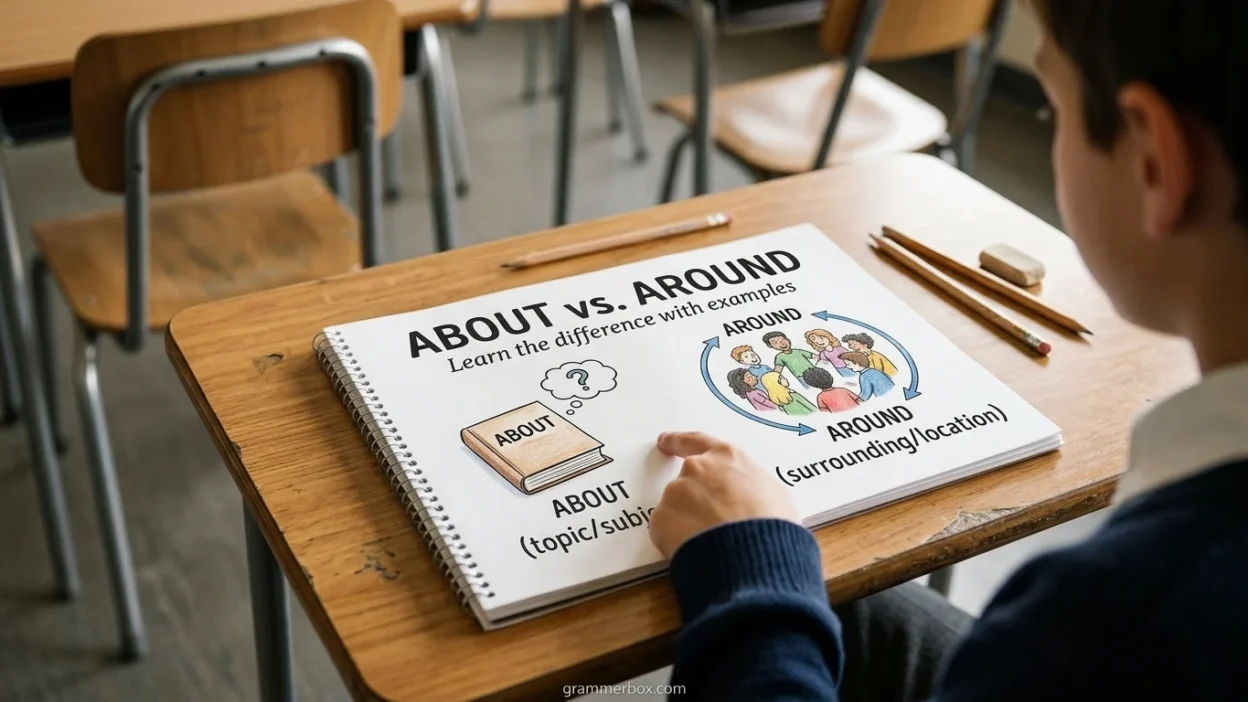
The words about and around are common in everyday English, but choosing between them can sometimes be confusing. Both words can describe something related to a subject, an approximate amount, or a position. However, they are not always interchangeable. Understanding their differences can help you communicate more clearly and avoid common grammar mistakes.
For example, you might say, “We talked about the new project” when discussing a particular subject. However, “We walked around the park” describes movement within or along an area. Interestingly, both words can also express approximation, as in “about ten people” and “around ten people.” In this guide, we will explore about vs. around, explain their meanings, compare their grammatical uses, and provide practical examples. Whether you are a student, ESL learner, writer, or English enthusiast, you will learn how to use both words naturally and confidently.
Quick Answer
About usually means concerning a subject or approximately a certain amount. Around generally means surrounding a place, moving in different directions, or approximately a number or time. Both can express approximation, but their other meanings and grammatical uses are different.
Why People Confuse It
People often confuse about and around because both words can communicate the idea of approximation. In many sentences, they can replace each other without changing the basic meaning.
For example:
- There were about 20 students in the classroom.
- There were around 20 students in the classroom.
Both sentences suggest that the number of students was close to 20.
However, their meanings become different in other situations. About commonly introduces a topic, while around describes movement, position, or something surrounding a particular area.
Consider these examples:
- I read a book about history. (The book’s subject is history.)
- I walked around the museum. (I moved through or near the museum.)
The confusion happens because learners focus on their shared meaning instead of considering the context of the sentence.
About
About is a preposition and adverb that generally means concerning, related to, or approximately. It is one of the most frequently used words in English.
It helps introduce a subject, describe an approximate amount, or communicate something related to a particular matter.
Meanings of About
1. Concerning or Related To
Use about when talking or writing about a particular subject, person, or situation.
Examples:
- We talked about our future plans.
- This book is about English grammar.
- I want to learn about American history.
- She asked me about my job.
- The teacher explained something about punctuation.
2. Approximately or Nearly
About can describe an estimated number, measurement, amount, or time.
Examples:
- The journey takes about two hours.
- There are about 50 people here.
- My brother is about six feet tall.
- The meeting starts at about 9 a.m.
- This laptop costs about $800.
3. In Different Directions or Nearby
About can also describe movement or activity in different directions, although this usage is more common in certain expressions and varieties of English.
Examples:
- He looked about the room.
- People were moving about the building.
- She wandered about the garden.
When to Use About
Use about when you want to:
- Introduce the subject of a conversation or article.
- Explain what a book, movie, or lesson concerns.
- Give an approximate number or measurement.
- Describe an estimated time or amount.
- Use common expressions such as think about, talk about, and worry about.
Around
Around is a preposition and adverb that generally means surrounding, in a nearby area, moving in a circular direction, or approximately.
It is frequently used to describe physical locations, movement, and estimated quantities.
Meanings of Around
1. Surrounding Something
Use around when something is positioned on different sides of a person, object, or place.
Examples:
- There are trees around the house.
- The children gathered around their teacher.
- She tied a ribbon around the gift.
- A fence runs around the garden.
- We sat around the table.
2. Moving in a Particular Area
Around can describe movement within or through an area without necessarily following a straight path.
Examples:
- We walked around the city.
- The children ran around the playground.
- He looked around the room.
- She traveled around Europe.
- They drove around the neighborhood.
3. Approximately or Nearly
Like about, around can express an estimated amount, number, distance, or time.
Examples:
- There were around 100 guests at the wedding.
- I will arrive around 7 p.m.
- The building is around 20 years old.
- It costs around $50.
- We waited for around 30 minutes.
4. Available or Present
Around can also mean present or available in a particular place.
Examples:
- Is your brother around?
- There is nobody around to help us.
- I will be around this afternoon.
When to Use Around
Use around when you want to:
- Describe something surrounding another object.
- Explain movement within an area.
- Talk about nearby locations.
- Give an approximate time, number, or measurement.
- Say that someone or something is present or available.
About vs. Around: Comparison Table
Although both words can express approximation, their meanings and grammatical functions depend on the context.
| Feature | About | Around |
|---|---|---|
| Main meaning | Concerning or approximately | Surrounding or approximately |
| Part of speech | Preposition, adverb | Preposition, adverb |
| Subject or topic | Very common | Not usually used this way |
| Approximate numbers | Yes | Yes |
| Approximate time | Yes | Yes |
| Physical position | Limited usage | Very common |
| Movement | Used in some expressions | Very common |
| Nearby presence | Less common | Very common |
| Example | A story about animals | Walking around the park |
When to Use Each
Choosing between about and around becomes easier when you understand what you want to communicate.
Use About for Topics and Subjects
When discussing a particular subject, about is generally the correct choice.
- We learned about climate change.
- She wrote an article about healthy eating.
- They talked about their vacation.
Avoid using around in these sentences when you mean concerning a topic.
Use Around for Physical Position
When describing something surrounding another object or person, use around.
- A wall was built around the property.
- The children stood around their mother.
- There are flowers around the fountain.
Use Both for Approximation
When expressing an estimated quantity, time, or measurement, both words are generally acceptable.
- It takes about 15 minutes.
- It takes around 15 minutes.
Both sentences communicate nearly the same meaning.
However, context and writing style can influence which option sounds more natural.
Use Around for Movement
When describing movement within an area, around is usually the better choice.
- We walked around the shopping mall.
- The dog ran around the garden.
- He drove around the city.
About does not normally replace around in these examples.
Examples of About vs. Around
Here are 16 practical examples to help you understand the difference between these two commonly confused words.
Examples Using About
- I want to know more about your business.
- She told me about her childhood.
- We had a long conversation about education.
- This documentary is about wildlife.
- He worries about his examination results.
- The journey takes about three hours.
- There are about 25 books on the shelf.
- The package weighs about five kilograms.
Examples Using Around
- We walked around the lake.
- The children gathered around the teacher.
- There is a beautiful garden around the house.
- He looked around the classroom.
- I will meet you around noon.
- There were around 40 people at the event.
- She traveled around the world.
- My office is around the corner.
Examples Using Both Words
Some sentences allow both words without changing their essential meaning.
- About 100 people attended the event.
- Around 100 people attended the event.
Another example:
- The meeting will begin at about 10 o’clock.
- The meeting will begin at around 10 o’clock.
Both versions are grammatically acceptable.
Common Mistakes
Even experienced English speakers sometimes use about and around incorrectly. Here are some mistakes worth avoiding.
Mistake 1: Using Around for a Subject
Incorrect: I want to learn around English grammar.
Correct: I want to learn about English grammar.
Explanation: Use about when introducing a topic or subject.
Mistake 2: Using About for Physical Surroundings
Incorrect: The children stood about the table.
Correct: The children stood around the table.
Explanation: Around is the natural choice when describing objects or people positioned around something.
Mistake 3: Confusing Approximation With Exact Numbers
Incorrect: There were exactly about 50 people.
Better: There were about 50 people.
Explanation: About already indicates an approximation, so combining it with exactly creates an unnecessary contradiction.
Mistake 4: Using About Instead of Around for Movement
Incorrect: We walked about the park.
Better: We walked around the park.
Explanation: Around is more natural in modern everyday English when describing movement through or along an area.
Mistake 5: Assuming Both Words Are Always Interchangeable
Incorrect: This article is around grammar.
Correct: This article is about grammar.
Explanation: Although both words can indicate approximation, they have different meanings in other contexts.
Memory Trick
Remember these two simple rules:
- About = Topic: Think about a subject, conversation, or approximate amount.
- Around = Surrounding: Think about something surrounding an object, moving through an area, or an approximate amount.
A simple way to remember the difference is:
About tells you what something concerns, while around tells you where something is or how it moves.
For approximation, remember that both words can work.
American vs. British English
The words about and around are used in both American and British English. Their basic meanings and grammatical functions remain almost identical across these varieties.
However, there can be slight differences in everyday preferences and expressions.
| Usage | American English | British English |
|---|---|---|
| Talking about a subject | About | About |
| Describing surroundings | Around | Around |
| Approximate time | About 5 p.m. | About 5 p.m. |
| Approximate quantity | Around 20 people | Around 20 people |
| Moving through an area | Walking around | Walking around |
Both varieties commonly use about for topics and around for physical surroundings.
British English also uses expressions such as round the corner where American English commonly uses around the corner. Both are understandable, although regional preferences differ.
There is no major American-versus-British spelling difference between about and around.
Similar Words
Several English words have meanings related to about and around. Understanding these alternatives can help you expand your vocabulary and choose more precise expressions.
| Word | Meaning | Example |
|---|---|---|
| Approximately | Nearly or close to | Approximately 100 people attended. |
| Roughly | About or nearly | It costs roughly $30. |
| Concerning | Related to a subject | I have a question concerning your project. |
| Regarding | In connection with | We spoke regarding the new policy. |
| Surrounding | Located around something | The surrounding area is beautiful. |
| Nearby | Not far away | There is a nearby restaurant. |
| Near | Close to something | My school is near the library. |
| Circling | Moving around something | Birds were circling the building. |
Remember that these words are not always interchangeable. Choose an alternative based on the meaning and structure of your sentence.
FAQs:
1. What is the main difference between about and around?
About usually introduces a topic or describes an approximate amount. Around describes something surrounding an object, movement through an area, or an approximate amount.
2. Can about and around be used interchangeably?
Sometimes. Both words can express approximation, such as about 20 people and around 20 people. However, they cannot replace each other in every sentence.
3. Is it about 5 or around 5?
Both expressions are correct. They mean approximately five, whether you are referring to a time, quantity, or measurement.
4. Should I say a book about or a book around?
You should say a book about when describing its subject.
Example: I bought a book about science.
Around does not normally introduce the subject of a book.
5. Is around more informal than about?
Around can sound conversational in some contexts, especially when discussing approximate times and quantities. However, both words are widely accepted in everyday and formal English.
6. Is about a preposition or an adverb?
About can function as both a preposition and an adverb.
Example as a preposition: We talked about the problem.
Example as an adverb: The children were running about.
7. Can around mean approximately?
Yes. Around frequently means approximately or nearly when describing quantities, distances, ages, and times.
Example: The journey takes around four hours.
Final Verdict
The difference between about vs. around depends mainly on the meaning you want to express. Use about when discussing a topic, introducing a subject, or giving an approximate amount. Use around when describing something surrounding an object, movement through an area, nearby presence, or an estimated quantity.
Both words are correct when expressing approximation, so you can often choose either one in sentences such as “about 50 people” and “around 50 people.” However, they are not interchangeable in every situation. Pay attention to the context, and your word choice will become much easier.
Remember This
- About: Use it for subjects, conversations, and approximate amounts.
- Around: Use it for surroundings, movement, nearby locations, and approximate amounts.
- Both: Use either when expressing an approximate number, time, or measurement.
The easiest rule is: About is usually about the topic; around is usually about the surrounding area.
Conclusion
Learning the difference between about and around can improve your everyday communication and English writing. Although these words share the meaning of approximately, they perform different roles in many sentences. Understanding when to use each word will help you avoid confusing expressions and communicate your ideas more accurately.
Keep practicing with real-life examples, conversations, and short writing exercises. Remember that about generally introduces a subject, while around describes surrounding positions and movement. Once you understand these basic distinctions, choosing the correct word will become natural and effortless.