English spelling can be confusing, especially when two words look almost identical but only one is accepted in standard usage. Smooth or smoothe is a good example. If you want to describe something without bumps, roughness, or interruptions, you might wonder whether to write smooth or smoothe. The extra “e” may seem natural because many English verbs end in “e,” but spelling rules do not always work that way.
Understanding the difference is important for students, ESL learners, writers, and anyone who wants to improve their English vocabulary. Using the correct spelling makes your writing clearer and more professional. In this guide, we will explain the meaning of smooth, why smoothe is considered incorrect, and how to use the correct word in everyday sentences. You will also find practical examples, common mistakes, and simple memory tricks to help you remember the right spelling.
Quick Answer
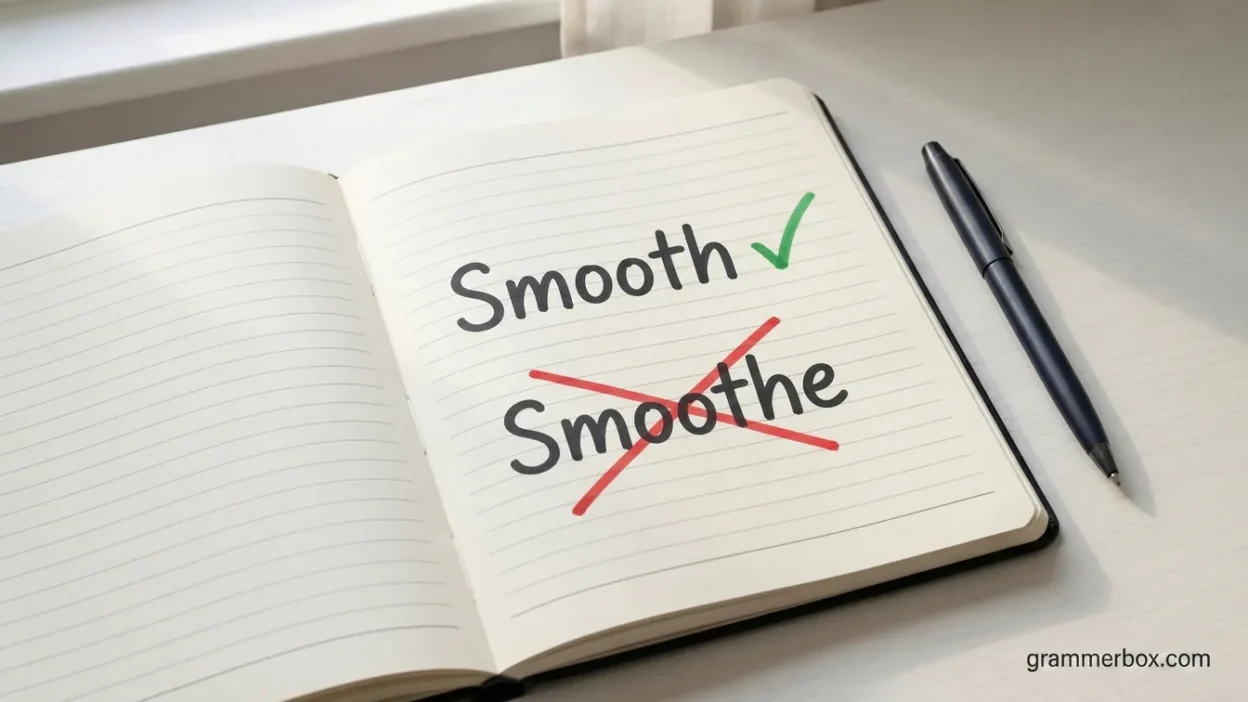
Smooth is the correct spelling in standard English. It can function as an adjective, verb, and noun, depending on the context. Smoothe is a common misspelling and is not accepted as the standard spelling. Always write smooth when describing something even, soft, or free from difficulties.
Why People Confuse It
People often confuse smooth and smoothe because English contains many words that end in a silent “e.” For example, words such as breathe, soothe, and clothe may make writers assume that smooth needs the same ending.
Another reason is pronunciation. Both spellings would likely be pronounced the same way, so hearing the word does not help people identify the correct spelling.
However, English spelling depends on established word forms rather than simply adding letters that seem familiar. The accepted spelling is smooth, without an additional “e.”
Remember these points:
- Smooth is the standard English spelling.
- Smoothe is a nonstandard misspelling.
- Smooth can be used as an adjective, verb, or noun.
- Adding an extra “e” does not make the word more correct.
First Word: Smooth
Smooth is the correct and widely accepted English word. It describes something that is even, soft, flat, or free from roughness. It can also describe an action that makes something more even or a process that happens without problems.
Meaning of Smooth
As an adjective, smooth describes a surface, texture, movement, sound, or experience that has no noticeable roughness or interruptions.
As a verb, it means to make something even, flat, or less rough. It can also mean to reduce difficulties in a situation.
As a noun, it appears in certain expressions, such as the smooth of the surface, although this use is less common.
Examples of Smooth
- The table has a smooth wooden surface.
- Her skin feels soft and smooth.
- We enjoyed a smooth journey through the countryside.
- He used sandpaper to smooth the rough edges.
- The singer has a beautiful, smooth voice.
- She tried to smooth things over after the disagreement.
- Apply the cream evenly to achieve a smooth finish.
Synonyms of Smooth
Depending on the context, some useful synonyms include:
- Even
- Flat
- Soft
- Silky
- Sleek
- Polished
- Gentle
- Effortless
- Uninterrupted
- Seamless
Second Word: Smoothe
Smoothe is not the standard spelling of the word smooth. Although people sometimes write it this way, particularly when they are unsure about the final letter, standard English dictionaries recognize smooth as the correct form.
Meaning of Smoothe
Smoothe does not have an accepted independent meaning in standard modern English. It is generally considered a spelling mistake rather than a separate vocabulary word.
For example:
- Incorrect: She wants to smoothe her hair.
- Correct: She wants to smooth her hair.
- Incorrect: Use a brush to smoothe the surface.
- Correct: Use a brush to smooth the surface.
Why Is Smoothe Incorrect?
The word smooth already has its complete and correct spelling. There is no grammatical rule requiring an extra “e” at the end.
Unlike soothe or breathe, the word smooth does not take an additional final “e.” Therefore, adding one creates a nonstandard spelling.
Smooth vs. Smoothe: Comparison Table
| Feature | Smooth | Smoothe |
|---|---|---|
| Spelling | Correct | Incorrect |
| Dictionary status | Standard English word | Nonstandard spelling |
| Meaning | Even, soft, or without difficulty | No standard meaning |
| Part of speech | Adjective, verb, noun | Not a standard word |
| Usage | Accepted in writing | Avoid in formal writing |
| Example | Smooth surface | Smoothe surface |
The main difference is simple: smooth is correct, while smoothe is a misspelling.
When to Use Each
Knowing when to use smooth is easy once you understand its different grammatical functions. Since smoothe is not a standard spelling, you should avoid using it in everyday or professional writing.
When to Use Smooth
Use smooth when describing something without bumps, roughness, or interruptions.
1. To describe a surface
- The stone has a smooth surface.
- This paper feels smooth to the touch.
2. To describe movement
- The car made a smooth turn.
- The dancer moved with smooth movements.
3. To describe communication or experiences
- We had a smooth conversation.
- Everything went smoothly during the meeting.
4. To describe an action
- Please smooth the fabric before sewing.
- She used a tool to smooth the plaster.
When to Avoid Smoothe
Avoid smoothe in:
- Academic assignments
- Business emails
- Professional documents
- Blog posts and articles
- Social media captions
- Everyday communication
Always choose smooth instead.
Examples of Smooth vs. Smoothe
Here are 12 examples to help you understand the correct spelling and recognize common mistakes.
- Correct: The baby has smooth skin.
Incorrect: The baby has smoothe skin. - Correct: She wants to smooth her hair.
Incorrect: She wants to smoothe her hair. - Correct: The road is smooth and safe.
Incorrect: The road is smoothe and safe. - Correct: Use sandpaper to smooth the wooden surface.
Incorrect: Use sandpaper to smoothe the wooden surface. - Correct: His voice sounds smooth and calming.
Incorrect: His voice sounds smoothe and calming. - Correct: We had a smooth flight despite the long journey.
Incorrect: We had a smoothe flight despite the long journey. - Correct: The painter tried to smooth the wall.
Incorrect: The painter tried to smoothe the wall. - Correct: This lotion makes your hands feel smooth.
Incorrect: This lotion makes your hands feel smoothe. - Correct: The new software provides a smooth user experience.
Incorrect: The new software provides a smoothe user experience. - Correct: He used a cloth to smooth the wrinkles.
Incorrect: He used a cloth to smoothe the wrinkles. - Correct: The meeting went smoothly without any problems.
Incorrect: The meeting went smoothely without any problems. - Correct: They worked together to smooth over the disagreement.
Incorrect: They worked together to smoothe over the disagreement.
These examples show that smooth is the correct spelling in every situation.
Common Mistakes
Even though smooth is a relatively simple word, writers sometimes make spelling and grammatical mistakes when using it.
Here are some mistakes to avoid:
1. Adding an extra “e”
- Incorrect: Smoothe
- Correct: Smooth
Do not add an extra letter to the end of the word.
2. Confusing smooth with smoothly
Smooth is commonly used as an adjective, while smoothly is an adverb.
- Correct: The road is smooth.
- Correct: The car moves smoothly.
3. Using smooth instead of smooths
When the subject is singular and the verb is in the present tense, the correct form is often smooths.
- Correct: She smooths her hair every morning.
- Incorrect: She smooth her hair every morning.
4. Confusing smooth and soothe
These words have different meanings:
- Smooth means even, soft, or free from roughness.
- Soothe means to calm or comfort someone.
5. Writing smoothely instead of smoothly
The correct adverb is smoothly, not smoothely.
Memory Trick: How to Remember Smooth
A simple spelling trick can help you avoid writing smoothe.
Remember this sentence:
“Smooth has no extra E.”
Think of the word smooth as complete without another letter at the end. Whenever you are unsure, remember that the correct spelling contains six letters: S-M-O-O-T-H.
You can also remember these examples:
- Smooth surface
- Smooth hair
- Smooth journey
- Smooth voice
Practice writing these expressions to make the correct spelling familiar.
American vs. British English
There is no spelling difference between American and British English when it comes to smooth.
Both varieties use smooth as the correct spelling. The word smoothe is not a standard alternative in either variety.
| English Variety | Correct Spelling | Incorrect Spelling |
|---|---|---|
| American English | Smooth | Smoothe |
| British English | Smooth | Smoothe |
| Canadian English | Smooth | Smoothe |
| Australian English | Smooth | Smoothe |
For example:
- American English: The road has a smooth surface.
- British English: The road has a smooth surface.
The spelling remains exactly the same, regardless of the variety of English you use.
Similar Words
Learning words that look or sound similar can help you improve your vocabulary and avoid spelling mistakes.
Here are some related words:
| Word | Meaning | Example |
|---|---|---|
| Soothe | To calm or comfort | Music can soothe the mind. |
| Silky | Soft and smooth | Her hair feels silky. |
| Sleek | Smooth and glossy | The car has a sleek design. |
| Even | Flat or level | Make the surface even. |
| Polish | To make something shiny or smooth | Polish the wooden table. |
| Rough | Not smooth | The wall feels rough. |
| Seamless | Without interruptions | The transition was seamless. |
| Soft | Gentle to the touch | The blanket is soft. |
These words are useful when describing textures, surfaces, appearances, and experiences.
FAQs:
1. Is smooth or smoothe correct?
Smooth is correct. Smoothe is a common misspelling and is not accepted as the standard spelling in modern English. Always write smooth when describing something even, soft, or free from roughness.
2. Is smoothe a real word?
Smoothe is not a standard English word. It sometimes appears as a spelling error, but it is not recognized as the correct form of smooth.
3. Why do people spell smooth as smoothe?
People often add an extra “e” because many English words end with a silent “e.” However, smooth already has its complete spelling and does not need another letter.
4. Is smooth an adjective or a verb?
Smooth can be both an adjective and a verb. As an adjective, it describes something even or soft. As a verb, it means to make something flat, even, or less rough.
5. What is the adverb form of smooth?
The adverb form is smoothly. For example, “The machine runs smoothly” means that the machine operates without problems or interruptions.
6. Is smooth spelled the same in American and British English?
Yes. Both American and British English use smooth. There is no regional spelling difference between these varieties.
7. What is the past tense of smooth?
The past tense is smoothed. For example, “She smoothed her dress before leaving.” The spelling does not change to smoothed.
Final Verdict
The correct spelling is smooth, not smoothe. It is a standard English word that can function as an adjective, verb, or noun. You can use it to describe soft textures, even surfaces, gentle movements, and experiences without difficulties. On the other hand, smoothe is simply a nonstandard spelling and should be avoided in formal and informal writing.
Whenever you are writing an email, completing an assignment, creating website content, or communicating in English, choose smooth. There is no need to add an extra “e” at the end. Remembering this simple spelling rule will help you write more accurately and confidently.
Remember This
- Smooth: Correct spelling in standard English.
- Smoothe: Incorrect, nonstandard spelling.
- Smoothly: Correct adverb form.
- Smoothed: Correct past-tense and past-participle form.
- Smoother: Correct comparative form.
The easiest rule to remember: Smooth is complete without an extra “e”!