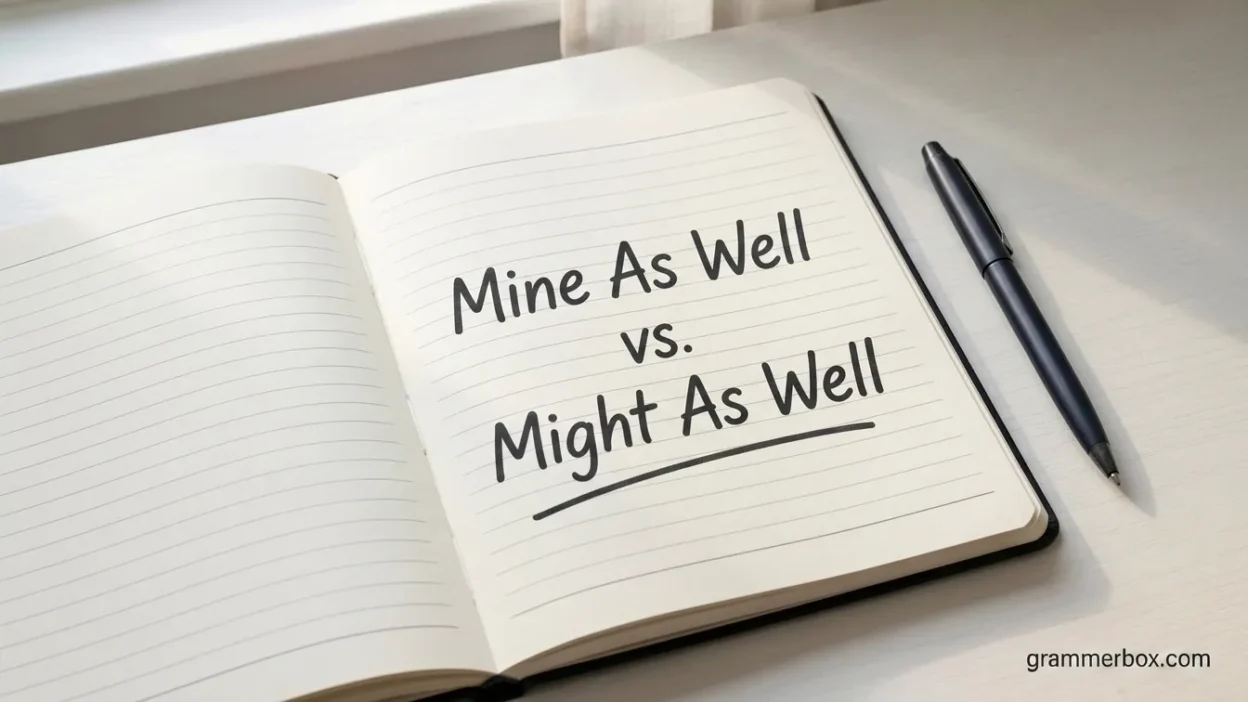
English contains many phrases that sound similar but have completely different meanings. “Mine as well” and “might as well” are a good example. If you have ever wondered which expression is correct, you are not alone. Many English learners and even native speakers confuse these phrases because they sound almost identical in everyday conversation.
However, only one is the standard expression: “might as well.” It is used when suggesting that someone should do something because there is little reason not to, or because it seems like the most practical choice. On the other hand, “mine as well” is generally a misspelling or mishearing of “might as well,” although the words can appear together in a sentence with a different grammatical meaning. Understanding this distinction will help you avoid common spelling mistakes and communicate more naturally in writing and conversation.
Quick Answer
“Might as well” is the correct expression when suggesting that something is a reasonable choice or that there is no better alternative. “Mine as well” is not a standard expression with this meaning. Use “might as well” in everyday conversations, emails, and formal writing.
Why People Confuse It
People confuse “mine as well” and “might as well” primarily because of their similar pronunciation in fast, informal speech.
When native English speakers say “might as well” quickly, the sounds can blend together. The phrase may sound like “mine as well” to someone who is unfamiliar with its correct spelling.
There are three main reasons behind this confusion:
- Similar pronunciation: Both expressions can sound alike in casual conversation.
- Spelling confusion: People may mistakenly hear “mine” instead of “might.”
- Unfamiliarity with idioms: English learners may not recognize “might as well” as a fixed expression.
The easiest way to avoid this mistake is to understand what the phrase means rather than relying only on how it sounds.
First Word: Mine as Well
“Mine as well” is generally incorrect when someone intends to say “might as well.” However, the words mine and as well can appear together naturally when they have separate grammatical functions.
The word “mine” is a possessive pronoun. It indicates that something belongs to the speaker.
For example:
- That blue notebook is mine.
- Your phone is newer, but mine works perfectly.
- Her house is larger than mine.
You can also use “mine” in a sentence followed by “as well” when the meaning is appropriate.
Examples:
- That backpack is mine as well as yours.
- The responsibility is mine as well.
- This seat is mine, and that one is yours.
- The final decision is mine as well as the manager’s.
Notice that these sentences use “mine” to indicate ownership or responsibility. They do not use “mine as well” as a replacement for “might as well.”
Important: If you want to suggest doing something because it seems reasonable, do not write “mine as well.” Write “might as well.”
Second Word: Might as Well
“Might as well” is a common English expression used to suggest doing something because it is practical, convenient, or better than doing nothing.
It can also express a decision made when there is no strong reason to choose another option.
The expression combines “might,” “as,” and “well,” but its meaning is not simply the sum of those individual words.
Examples:
- We might as well leave now because the meeting is over.
- You might as well ask the teacher for help.
- It’s raining, so we might as well stay inside.
- Since you’re already here, you might as well join us.
- I might as well finish this assignment tonight.
- We might as well take a taxi instead of waiting.
- If nobody wants the tickets, I might as well use them.
- You might as well tell her the truth.
- The store is closing, so we might as well go home.
- Since we have extra time, we might as well review the lesson.
In each example, the speaker suggests an action that seems sensible under the circumstances.
Different Ways to Use Might as Well
You can use this expression in several situations:
- Making suggestions: We might as well order some food.
- Accepting a situation: I might as well wait here.
- Choosing a practical option: We might as well walk home.
- Expressing resignation: There’s nothing else to do, so I might as well try.
Comparison Table
| Feature | Mine as Well | Might as Well |
|---|---|---|
| Grammatical use | Not a standard fixed expression | Common English expression |
| Meaning | Usually a mistaken version of the other phrase | A practical suggestion or reasonable choice |
| Correctness | Incorrect for the intended idiomatic meaning | Correct |
| Common usage | Usually a spelling or hearing mistake | Everyday English |
| Example | Mine as well go. (Incorrect) | We might as well go. (Correct) |
| Context | Possession when used grammatically | Suggestions and decisions |
When to Use Each
Choosing between these expressions becomes easier when you understand their intended meanings.
When to Use Mine as Well
Use “mine” when talking about something that belongs to you. Add “as well” when you want to communicate that something also applies to you.
Examples:
- This laptop is mine as well.
- The responsibility is mine as well.
- That opinion is mine as well as yours.
Remember that “mine” is a possessive pronoun, not a substitute for “might.”
When to Use Might as Well
Use “might as well” when you want to suggest an action that seems reasonable or practical.
Examples:
- We might as well start early.
- You might as well take a break.
- I might as well call him now.
- Since we are already here, we might as well explore the city.
This expression is especially useful when accepting circumstances or choosing the easiest available option.
Examples of Mine as Well vs. Might as Well
Here are 15 examples to help you understand the difference and use each expression correctly.
Correct Examples of Might as Well
- We might as well begin the project today.
- You might as well bring your umbrella because it may rain.
- Since the bus is late, we might as well walk.
- I might as well complete my homework before dinner.
- They might as well stay another night.
- If you’re going to the market, you might as well buy some milk.
- The movie starts in five minutes, so we might as well hurry.
- I have nothing planned, so I might as well visit my friend.
- Since everyone is here, we might as well start the meeting.
- You might as well save your work before closing the computer.
Correct Examples of Mine and As Well
- This jacket is mine as well.
- The responsibility for this project is mine as well.
- Your ideas are useful, and mine are as well.
- That decision was mine as well as yours.
- The final report is mine, and the presentation is mine as well.
These examples demonstrate that “mine” can appear with “as well” in a grammatically meaningful sentence, but it does not replace the idiom “might as well.”
Common Mistakes
Even experienced English users sometimes make mistakes with similar-sounding expressions. Here are some common errors to avoid.
Mistake 1: Using mine instead of might
- Incorrect: We mine as well leave now.
- Correct: We might as well leave now.
Mistake 2: Using the wrong expression in a suggestion
- Incorrect: You mine as well try again.
- Correct: You might as well try again.
Mistake 3: Assuming both expressions have the same meaning
“Mine” indicates possession, while “might as well” suggests a practical action. They are not interchangeable.
Mistake 4: Forgetting the word might
- Incorrect: I as well go home.
- Correct: I might as well go home.
Mistake 5: Writing based only on pronunciation
Don’t rely entirely on how a phrase sounds. Learn its meaning and grammatical structure before choosing the spelling.
Memory Trick
A simple memory trick can help you remember the difference between “mine as well” and “might as well.”
Think of MIGHT as a suggestion and MINE as ownership.
- MIGHT: Think about what you might do. Example: I might as well study tonight.
- MINE: Think about something that belongs to you. Example: This book is mine.
Whenever you want to suggest a reasonable action, remember to use “might as well.”
This simple association will help you avoid confusing the two expressions in your writing.
American vs. British English
There is no significant difference between American and British English when it comes to the expression “might as well.”
Both varieties use the same spelling, grammatical structure, and general meaning.
| Usage | American English | British English |
|---|---|---|
| Correct expression | Might as well | Might as well |
| Spelling | Might as well | Might as well |
| Meaning | A practical suggestion | A practical suggestion |
| Informal conversation | Common | Common |
| Mine as well as a substitute | Incorrect | Incorrect |
Examples:
- American English: We might as well get started.
- British English: We might as well get started.
Both sentences are correct and natural.
Although pronunciation and accents may differ between regions, the standard written expression remains the same.
Similar Words and Expressions
Several English expressions have meanings related to “might as well.” Learning them can help you expand your vocabulary and communicate more naturally.
| Expression | Meaning | Example |
|---|---|---|
| May as well | A reasonable action to take | We may as well leave now. |
| Could just as well | An equally reasonable alternative | We could just as well walk. |
| Why not | A suggestion or invitation | Why not give it a try? |
| Might just as well | A practical choice | I might just as well finish it. |
| Better off | In a more advantageous position | You’re better off waiting. |
| No harm in | Something unlikely to cause problems | There’s no harm in asking. |
| Go ahead | Proceed with an action | You might as well go ahead. |
These expressions are not always interchangeable, but they can communicate similar ideas depending on the context.
FAQs:
1. Is it mine as well or might as well?
“Might as well” is correct when suggesting that someone should do something because it seems reasonable. “Mine as well” is not a standard alternative to this expression.
2. Why do people say mine as well?
Some people mistakenly hear or spell “might as well” as “mine as well” because the expressions can sound similar in fast, informal speech.
3. Is might as well grammatically correct?
Yes. “Might as well” is a grammatically correct and widely accepted English expression. It is commonly used to suggest a practical or reasonable action.
4. What does might as well mean?
“Might as well” means that doing something seems reasonable, convenient, or worthwhile under the circumstances. For example, “We might as well go home.”
5. Can I use may as well instead of might as well?
Yes. “May as well” and “might as well” are often interchangeable when making practical suggestions. For example, “We may as well leave now” and “We might as well leave now.”
6. Is might as well formal or informal?
“Might as well” is commonly used in everyday conversation and is also acceptable in professional and formal writing when the context is appropriate.
7. Is mine as well ever correct?
Yes, but only when “mine” has its normal possessive meaning and “as well” means also. For example, “This responsibility is mine as well.” It is not correct as a replacement for “might as well.”
Final Verdict
The correct expression for suggesting a practical action is “might as well,” not “mine as well.” Use it when you think doing something is reasonable, convenient, or better than choosing another option. For example, “We might as well start now” is a natural and grammatically correct sentence.
However, “mine” is also a correct English word when expressing ownership. You can use it with “as well” in sentences such as “This book is mine as well.” The important thing is to understand the difference between possession and suggestion. Once you recognize their meanings, choosing the correct expression becomes much easier.
Remember This
- Might as well: Use it to suggest a practical or reasonable action.
- Mine: Use it to show ownership or possession.
- Mine as well: Not a standard substitute for “might as well.”
- May as well: A commonly accepted alternative to “might as well.”
Quick tip: If you mean “there is no good reason not to do it,” always write “might as well.”
Conclusion
Understanding the difference between “mine as well” and “might as well” can help you improve your English spelling, grammar, and everyday communication. Although the expressions may sound similar, they serve different purposes. “Might as well” is the correct idiom for suggesting an action, while “mine” is a possessive pronoun used to indicate ownership.
When writing emails, completing assignments, or communicating online, pay attention to the meaning of the sentence rather than relying only on pronunciation. Remember that “might as well” is the expression you need when recommending a practical choice. With regular practice and the examples in this guide, you can use it confidently and avoid this common English mistake.