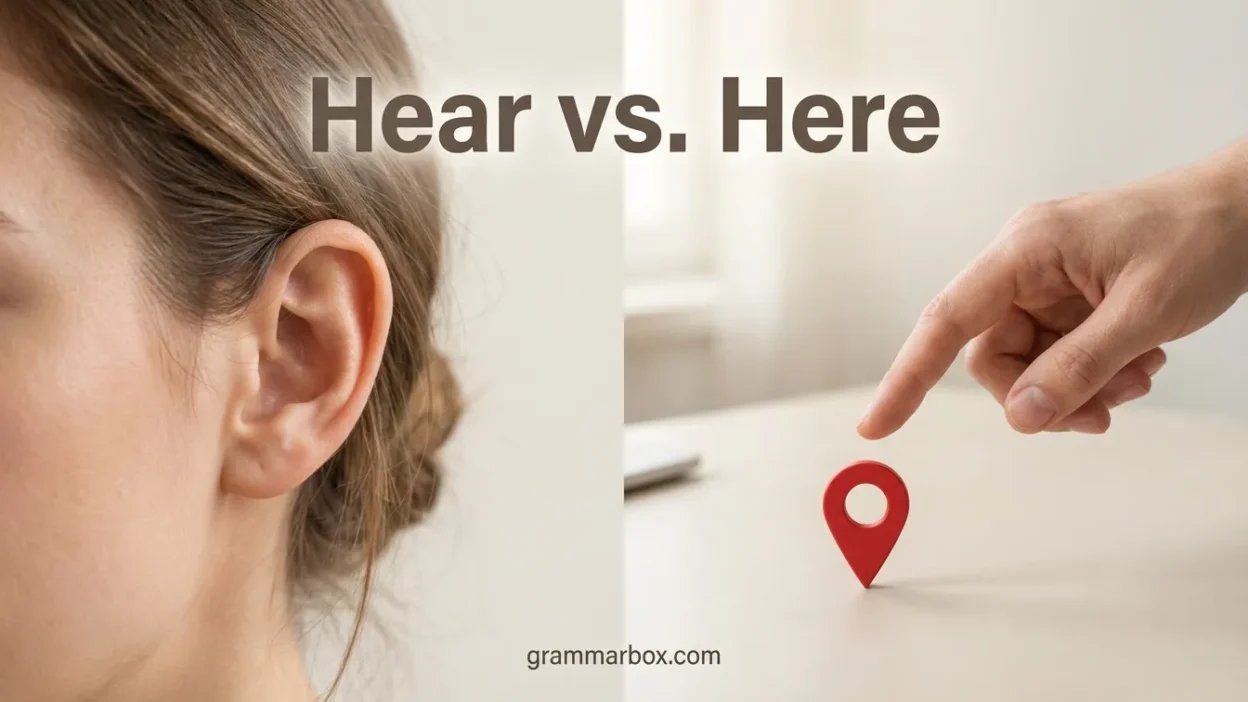
Have you ever confused hear vs. here while writing a sentence? These two words sound exactly alike, but their meanings and grammatical functions are completely different. One relates to your ability to listen, while the other refers to a place or position. Because they share the same pronunciation, even experienced English speakers sometimes mix them up in writing.
Understanding the difference between hear and here is essential for clear communication. If you are writing an email, completing an English assignment, creating content, or improving your everyday vocabulary, choosing the correct word makes your sentences more accurate. The good news is that you do not need to memorize complicated grammar rules to distinguish them. Once you understand their meanings, spelling, and common uses, you can easily avoid this mistake. In this guide, you will learn how to use hear and here correctly, explore practical examples, and discover a simple memory trick.
Quick Answer: Hear vs. Here
Hear is a verb that means to receive or perceive sound through your ears. Here is an adverb that refers to a place, meaning in or at this location. Both words sound identical but have different spellings, meanings, and grammatical uses.
Why People Confuse It
The main reason people confuse hear and here is that they are homophones. Homophones are words that have the same pronunciation but different meanings and spellings.
Both words are pronounced /hɪr/ in standard American English. When speaking, listeners generally understand which word someone means from the context. However, when writing, you must select the correct spelling.
Here are the main reasons for the confusion:
- Identical pronunciation: Hear and here sound exactly alike.
- Different meanings: One relates to sound, while the other identifies a location.
- Spelling similarities: Both words contain the same letters, arranged differently.
- Writing mistakes: People sometimes choose the wrong word because they rely on pronunciation instead of meaning.
For example:
- I can hear the music. (I can perceive the sound.)
- Please come here. (Come to this place.)
The surrounding sentence makes their meanings clear.
First Word: Hear
Hear is a verb that means to perceive, receive, or become aware of sounds through your ears. It describes the ability to recognize sounds, whether you are actively listening or simply noticing something.
You can hear music, voices, birds, announcements, and other sounds.
Meaning of Hear
According to its common English usage, hear can mean:
- To perceive sound through your ears.
- To receive information from someone.
- To listen to or consider someone’s opinion.
- To receive news or information about something.
Examples of Hear in Sentences
- I can hear someone knocking at the door.
- Did you hear the announcement?
- She loves to hear classical music.
- I want to hear your opinion.
- We could hear birds singing outside.
- Have you heard the latest news?
- I didn’t hear what you said.
- The judge will hear the case tomorrow.
Different Forms of Hear
Hear is an irregular verb, so its past forms do not follow the regular -ed pattern.
| Verb Form | Word | Example |
|---|---|---|
| Base form | Hear | I hear music. |
| Third-person singular | Hears | She hears everything. |
| Simple past | Heard | I heard a noise. |
| Past participle | Heard | Have you heard the news? |
| Present participle | Hearing | I am hearing strange sounds. |
Important: The past tense and past participle of hear are both heard, not heared.
Second Word: Here
Here is an adverb that refers to a particular place or location. It means in this place, at this location, or toward this position.
Unlike hear, here does not describe the ability to perceive sound. Instead, it helps identify where someone or something is located.
Meaning of Here
Here commonly has these meanings:
- In this place or location.
- At the current position.
- Toward or into this place.
- At this point in a discussion or situation.
Examples of Here in Sentences
- Please sit here beside me.
- I live here with my family.
- Your keys are here on the table.
- Come here for a moment.
- We have everything here.
- Is anyone here?
- I will wait for you here.
- Here is the book you requested.
Different Uses of Here
Here can appear in several sentence structures:
- Location: I am here at the office.
- Direction: Come here immediately.
- Introduction: Here is your coffee.
- Emphasis: Here comes the bus.
- Availability: Your documents are here.
Here is generally used to point out a location or introduce something that is present.
Hear vs. Here: Comparison Table
Although hear and here sound alike, their meanings and grammatical roles are different.
| Feature | Hear | Here |
|---|---|---|
| Meaning | To perceive sound | In this place |
| Part of speech | Verb | Adverb |
| Pronunciation | /hɪr/ | /hɪr/ |
| Main purpose | Describes hearing | Identifies location |
| Related concept | Sound and listening | Place and position |
| Past form | Heard | No verb forms |
| Example | I hear music. | I am here. |
The easiest way to remember the distinction is that hear relates to your ears, while here relates to your location.
When to Use Each
Choosing between hear and here becomes simple when you understand what your sentence communicates.
When to Use Hear
Use hear when your sentence discusses sounds, listening, or receiving information.
Common situations include:
- Listening to sounds: I hear the rain outside.
- Receiving information: I heard about your promotion.
- Asking for someone’s opinion: I would like to hear your thoughts.
- Listening to music: We hear music every morning.
- Understanding spoken words: I couldn’t hear the teacher clearly.
If your sentence involves something that can be heard or information that can be received, hear is generally the correct choice.
When to Use Here
Use here when you want to identify a place, position, or current location.
Common situations include:
- Describing your location: I am here at the library.
- Giving directions: Please come here.
- Pointing out an object: Your phone is here.
- Offering something: Here is your ticket.
- Identifying a position: We have reached here safely.
If your sentence answers the question “Where?”, here is usually the appropriate word.
Examples of Hear vs. Here in Sentences
The following examples show how these homophones work in everyday English.
- I can hear the birds singing here in the garden.
- Please come here so you can hear the instructions.
- Did you hear that noise coming from here?
- I want to hear your story while we sit here.
- She couldn’t hear the speaker from here.
- You can hear the ocean clearly from here.
- I am here because I want to hear the announcement.
- Can you hear me, or should I come over here?
- We heard the news while sitting here.
- The teacher asked everyone here to hear the important instructions.
- I love to hear music when I am here.
- Is your brother here, or should I call him?
- I didn’t hear the phone ringing while I was here.
- Come here if you want to hear something interesting.
- You can find all the information here, and you can contact us if you want to hear more.
These examples demonstrate that both words can appear in the same sentence without sharing the same meaning.
Common Mistakes
Writers and English learners sometimes use hear and here incorrectly because they sound identical. Here are some common mistakes and their corrections.
| Incorrect Sentence | Correct Sentence |
|---|---|
| I can here you. | I can hear you. |
| Come hear, please. | Come here, please. |
| Did you here the news? | Did you hear the news? |
| I am hear now. | I am here now. |
| Can you here me? | Can you hear me? |
| Your bag is hear. | Your bag is here. |
How to Avoid These Mistakes
Follow these simple tips:
- Check whether the sentence refers to sound or location.
- Remember that hear is a verb.
- Remember that here identifies a place.
- Read your sentence carefully before publishing or submitting it.
- Practice using both words in the same sentence.
One small spelling difference can completely change the meaning of your sentence.
Memory Trick: How to Remember Hear vs. Here
A simple memory trick can help you remember these words without memorizing complicated definitions.
Hear = Ear
Notice that the word hear contains the word ear, except for the letter arrangement. Your ears help you hear sounds.
Think of this sentence:
- I use my ears to hear music.
Here = Location
Think of here as a word that points to where you are.
For example:
- I am standing here.
You can also remember these two simple questions:
- Can you hear it? → Is there a sound?
- Are you here? → Are you at this place?
Quick memory tip: Hear is about your ears, and here is about your location.
American vs. British English
There is no spelling difference between hear and here in American and British English. Both varieties use the same spelling, meaning, and grammatical functions.
| Word | American English | British English |
|---|---|---|
| Hear | Hear | Hear |
| Here | Here | Here |
Their pronunciation is also essentially the same in both varieties, although individual accents may produce slight differences in vowel quality.
Examples:
- American English: I can hear you from here.
- British English: I can hear you from here.
Whether you are writing for an American or British audience, you should always distinguish these words according to their meanings.
Similar Words
Hear and here belong to a larger group of commonly confused English words. Learning other homophones can help improve your spelling, vocabulary, and writing accuracy.
Here are some useful examples:
| Word Pair | Meaning |
|---|---|
| Their vs. There | Belonging to them vs. a place |
| To vs. Too | Direction vs. also or excessively |
| See vs. Sea | To perceive with your eyes vs. a large body of salt water |
| Right vs. Write | Correct or a direction vs. to form words |
| Wear vs. Where | To have clothing on vs. asking about a place |
| By vs. Buy | Near or through vs. purchase |
| One vs. Won | The number 1 vs. past tense of win |
| No vs. Know | A negative response vs. to understand |
| Peace vs. Piece | Freedom from conflict vs. a portion |
| Allowed vs. Aloud | Permitted vs. spoken audibly |
These words may sound alike or similar, but their meanings and grammatical functions differ. Understanding their distinctions will make your English writing more precise.
FAQs:
1. What is the difference between hear and here?
Hear is a verb that means to perceive sounds through your ears. Here is an adverb that refers to a particular place or location. Both words sound alike but have different meanings and spellings.
2. Is hear or here correct?
Both words are correct English spellings, but they are used in different situations. Use hear when discussing sound or listening. Use here when referring to a location or position.
3. Are hear and here homophones?
Yes, hear and here are homophones because they have the same pronunciation but different spellings and meanings. Their pronunciation is generally identical in standard American and British English.
4. How do you remember the spelling of hear and here?
Remember that hear contains the idea of an ear, which helps you perceive sounds. Here refers to your current location. This simple association makes it easier to choose the correct word.
5. Is hear a noun or a verb?
Hear is primarily a verb. It describes the action or ability of perceiving sounds. For example, “I can hear the music” uses hear as a verb.
6. Is here a verb or an adverb?
Here is generally an adverb of place. It tells readers where someone or something is located. For example, “Your book is here” uses here to identify the book’s location.
7. Can hear and here be used in the same sentence?
Yes, both words can appear in the same sentence. For example, “I can hear the birds singing here.” Hear describes perceiving sound, while here identifies the location.
Final Verdict
The difference between hear and here is simple once you understand their meanings. Hear is a verb associated with listening, receiving sounds, and becoming aware of information. Here is an adverb that identifies a location or position. Although both words have identical pronunciation, they cannot be used interchangeably.
Whenever you are unsure which word to choose, consider the meaning of your sentence. If you are talking about something you can listen to, choose hear. If you are referring to a place or location, choose here. Practicing these two words in everyday sentences will help you develop stronger spelling habits and communicate more confidently.
Remember This
- HEAR = EAR: Use it when talking about sounds, listening, or receiving information.
- HERE = PLACE: Use it when referring to a location or position.
- Both words are homophones, so their pronunciation is the same.
- Never use hear and here interchangeably.
The easiest rule: You hear with your ears, but you are here in a place.