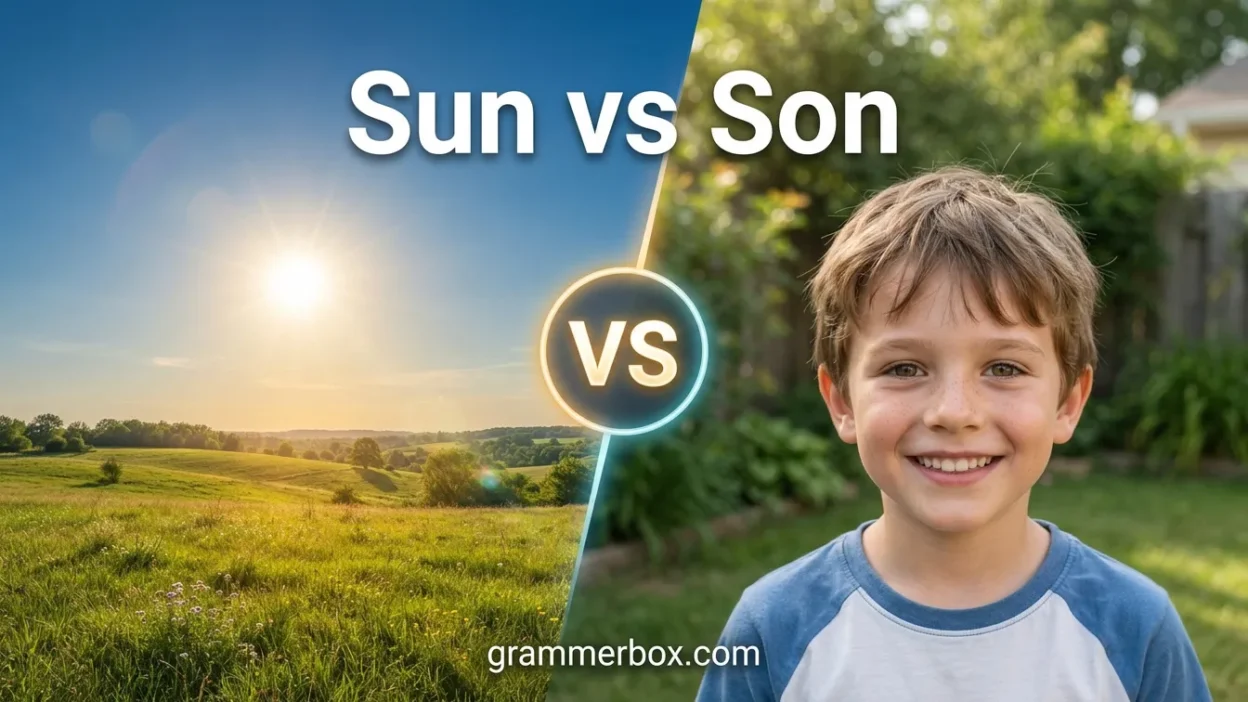
The English words sun vs son are often confused because they have exactly the same pronunciation but completely different meanings. Whether you are writing an email, completing a school assignment, or improving your English vocabulary, knowing which word to use can help you avoid spelling mistakes and communicate more clearly.
Although these words sound identical, they belong to different categories of meaning. Sun refers to the star that provides Earth with light and heat, while son describes a male child in relation to their parents. Their meanings are easy to remember once you understand how each word is used in everyday English. In this guide, you will learn the difference between sun and son, explore practical examples, discover common mistakes, and find simple memory tricks to help you use both words correctly.
Quick Answer: Sun vs Son
Sun refers to the star at the center of our solar system that gives Earth light and warmth. Son means a male child in relation to his parents. Both words are pronounced the same, but their meanings, spellings, and uses are completely different.
Why People Confuse It
People often confuse sun and son because they are homophones. Homophones are words that have the same pronunciation but different meanings and spellings.
Both words are pronounced /sʌn/, so you cannot distinguish them by listening alone. You need to understand the context of a sentence to identify the correct spelling.
Here are the main reasons for the confusion:
- Identical pronunciation: Both words sound exactly alike in standard English.
- Different meanings: One refers to a celestial object, while the other describes a family relationship.
- Similar spelling: Both words contain three letters and differ only in their middle vowel.
- Writing mistakes: People sometimes choose the wrong spelling when typing quickly or relying only on pronunciation.
Understanding their meanings makes it much easier to use them correctly.
First Word: Sun
Sun is a noun that refers to the star at the center of our solar system. It provides the Earth with light and heat, making life possible.
The sun is essential for plants, animals, and humans. It also plays an important role in weather patterns, seasons, and the natural environment.
Examples of Sun in Sentences:
- The sun rises in the east and sets in the west.
- We enjoyed sitting outside in the warm sun.
- The bright sun made the afternoon feel hotter.
- Plants need sunlight from the sun to grow.
- The sun disappeared behind the clouds.
- I love watching the sun rise over the mountains.
- The children played in the garden under the sun.
- Too much exposure to the sun can damage your skin.
- The sun provides energy to our planet.
- We watched the sun set over the ocean.
Common Expressions With Sun
The word sun also appears in several common English expressions:
- Sunlight: Natural light that comes from the sun.
- Sunshine: Direct sunlight or bright, cheerful weather.
- Sunrise: The time when the sun appears above the horizon.
- Sunset: The time when the sun disappears below the horizon.
- Sunburn: Skin damage caused by excessive exposure to ultraviolet radiation.
These expressions are commonly used in everyday conversations and writing.
Second Word: Son
Son is a noun that means a male child in relation to his parents. It describes a family relationship and is commonly used when talking about someone’s children.
For example, if parents have a male child, they can refer to him as their son. The word can also appear in expressions involving family history, relationships, and personal identity.
Examples of Son in Sentences:
- My son loves playing football after school.
- She is proud of her youngest son.
- Their son is studying at a local university.
- His son helped him repair the car.
- They have one daughter and two sons.
- My neighbor’s son is learning to drive.
- The proud father congratulated his son on graduating.
- Her son wants to become a doctor.
- He spends every weekend with his son.
- Their son celebrated his birthday yesterday.
Common Expressions With Son
Here are some familiar expressions that use the word son:
- Only son: A family’s one male child.
- Youngest son: The youngest male child in a family.
- Eldest son: The oldest male child in a family.
- Father and son: A relationship between a father and his male child.
- Son-in-law: The husband of someone’s daughter.
These expressions help describe family relationships more precisely.
Sun vs Son: Comparison Table
Although sun and son sound identical, their meanings and grammatical uses are different.
| Feature | Sun | Son |
|---|---|---|
| Meaning | The star at the center of our solar system | A male child |
| Part of speech | Noun | Noun |
| Pronunciation | /sʌn/ | /sʌn/ |
| Main context | Nature and astronomy | Family and relationships |
| Plural | Suns | Sons |
| Example | The sun is shining. | My son is sleeping. |
| Related word | Sunshine | Sonship |
The easiest way to distinguish them is to remember that sun relates to light and warmth, while son relates to family and children.
When to Use Each
Choosing between sun and son depends on what you want to communicate. Consider the subject of your sentence before selecting the spelling.
When to Use Sun
Use sun when discussing:
- The star that provides Earth with light and heat.
- Weather conditions and sunny days.
- Sunrise and sunset.
- Sunlight, sunshine, and sunburn.
- Astronomy and the solar system.
Examples:
- The sun is shining brightly today.
- We spent the afternoon enjoying the sun.
- The sun is the largest object in our solar system.
When to Use Son
Use son when discussing:
- A male child in a family.
- Relationships between parents and children.
- Family history and personal relationships.
- Someone’s male offspring.
Examples:
- Their son is very talented.
- My son wants to learn English.
- She introduced her son to her friends.
Quick tip: If your sentence is about the sky, light, or heat, choose sun. If it is about a male child or family relationship, choose son.
Examples of Sun vs Son in Sentences
The following examples demonstrate how both homophones work in everyday English.
Examples Using Sun
- The sun shines brightly during the summer.
- We should avoid staying in the sun for too long.
- The sun gives plants the energy they need.
- A beautiful sunset appeared over the horizon.
- The morning sun warmed our faces.
- The sun was hidden behind thick clouds.
- Solar panels convert energy from the sun into electricity.
- The sun rises earlier during certain seasons.
- She opened the curtains to let the sun into her room.
- The sun is approximately 150 million kilometers from Earth.
Examples Using Son
- My son is learning how to ride a bicycle.
- Their son won first prize in the competition.
- He took his son to the park.
- Her son enjoys reading adventure stories.
- The son thanked his parents for their support.
- My friend’s son is starting school next week.
- They celebrated their son’s graduation.
- His son inherited his father’s musical talent.
- The mother prepared breakfast for her son.
- Every parent wants the best for their son.
Examples Using Both Words Together
These sentences show how both words can appear in the same context.
- The son enjoyed playing outside in the warm sun.
- His son watched the sun disappear behind the hills.
- The father and son went for a walk in the sun.
- My son loves drawing pictures of the sun.
- The son wore sunglasses to protect his eyes from the sun.
Common Mistakes
Because sun and son have identical pronunciations, even experienced English writers can occasionally mix them up.
Here are some common mistakes and their corrections.
| Incorrect Sentence | Correct Sentence | Explanation |
|---|---|---|
| My sun is ten years old. | My son is ten years old. | A male child is a son. |
| The son is shining brightly. | The sun is shining brightly. | The star is the sun. |
| I took my sun to school. | I took my son to school. | A family relationship requires son. |
| The sun played football. | The son played football. | A person plays football. |
| We enjoyed the warmth of the son. | We enjoyed the warmth of the sun. | The sun provides warmth. |
How to Avoid These Mistakes
- Read the entire sentence before choosing a spelling.
- Think about whether you are discussing nature or family.
- Remember that son refers to a male child.
- Associate sun with sunlight, sunshine, and sunrise.
- Proofread your writing to catch homophone errors.
Memory Trick: How to Remember Sun vs Son
A simple memory trick can help you remember the difference between these two words.
Sun = Sky
Both words start with the letter S, but you can associate sun with the sky, sunlight, and sunshine.
Son = Family
Think of the word son when talking about a father, mother, brother, or child.
Here is another easy way to remember:
- Sun: Think of a sunny day.
- Son: Think of someone’s male child.
You can also remember this simple sentence:
“My son enjoys playing outside under the sun.”
This sentence uses both words correctly and makes their different meanings easier to remember.
American vs British English
There is no spelling difference between sun and son in American and British English.
Both varieties of English use the same spellings and meanings. Their pronunciation is also generally the same, although regional accents can create small differences in vowel sounds.
| Word | American English | British English |
|---|---|---|
| Sun | Sun | Sun |
| Son | Son | Son |
| Pronunciation | /sʌn/ | /sʌn/ |
| Meaning | Same | Same |
For example:
- American English: My son loves sitting in the sun.
- British English: My son loves sitting in the sun.
Both sentences are grammatically correct.
Therefore, you do not need to worry about choosing different spellings based on your audience’s location.
Similar Words
Sun and son belong to a group of English words called homophones. These words sound alike but have different spellings and meanings.
Learning other common homophones can help improve your spelling, vocabulary, and writing skills.
Here are some useful examples:
| Word Pair | Meaning |
|---|---|
| Sun / Son | A star / A male child |
| Sea / See | Ocean / To look |
| One / Won | Number 1 / Past tense of win |
| Their / There | Belonging to them / A place |
| Right / Write | Correct / To form words |
| Hear / Here | To perceive sound / This place |
| Pair / Pear | Two matching things / A fruit |
| Flower / Flour | A plant / Baking ingredient |
| Week / Weak | Seven days / Not strong |
| Knight / Night | A medieval warrior / Darkness after sunset |
Understanding these word pairs will help you recognize how pronunciation and spelling work differently in English.
FAQs:
1. What is the difference between sun and son?
Sun refers to the star at the center of our solar system, while son means a male child in relation to his parents. They sound the same but have different meanings and spellings.
2. Are sun and son homophones?
Yes, sun and son are homophones because they have identical pronunciations but different spellings and meanings. They are pronounced /sʌn/ in standard English.
3. Is it my sun or my son?
The correct expression is my son when referring to your male child. The word sun refers to the star that provides Earth with light and heat.
4. Why do sun and son sound the same?
Both words have the same pronunciation because they share the same vowel and ending sounds. However, their spellings and meanings developed differently throughout the history of English.
5. What is the plural of son?
The plural of son is sons. For example, “They have three sons and one daughter.”
6. What is the plural of sun?
The plural of sun is suns. It is used when discussing multiple stars, such as suns in different solar systems.
7. Do sun and son have the same pronunciation in American and British English?
Generally, yes. Both words are pronounced /sʌn/ in standard American and British English, although regional accents may affect the exact sound.
Final Verdict
The difference between sun vs son is simple once you understand their meanings. Sun refers to the star that provides light and warmth to Earth, while son describes a male child in relation to his parents. Although both words sound identical, they cannot be used interchangeably.
Remember to use sun when discussing sunlight, sunshine, weather, or astronomy. Choose son when talking about family relationships, parents, or male children. Paying attention to the context of your sentence will help you select the correct spelling every time.
Remember This
- Sun = The star that provides Earth with light and heat.
- Son = A male child in a family.
- Both = Homophones with identical pronunciation but different meanings and spellings.
Easy reminder: The sun shines in the sky, and a son belongs to a family.
Conclusion
Understanding the difference between sun and son is an easy way to improve your English spelling and vocabulary. Although these words sound exactly alike, their meanings are completely different. Sun is associated with astronomy, sunlight, and warmth, whereas son describes a male child and family relationships.
The best way to avoid confusing these homophones is to focus on the context of your sentence. Practice using both words in everyday conversations and written examples. With a little attention and repetition, you will confidently know when to write sun and when to write son.